Certificate in American Studies
Learn about American power and influence in the world by studying the cultural, political, economic, and religious forces driving foreign policy.
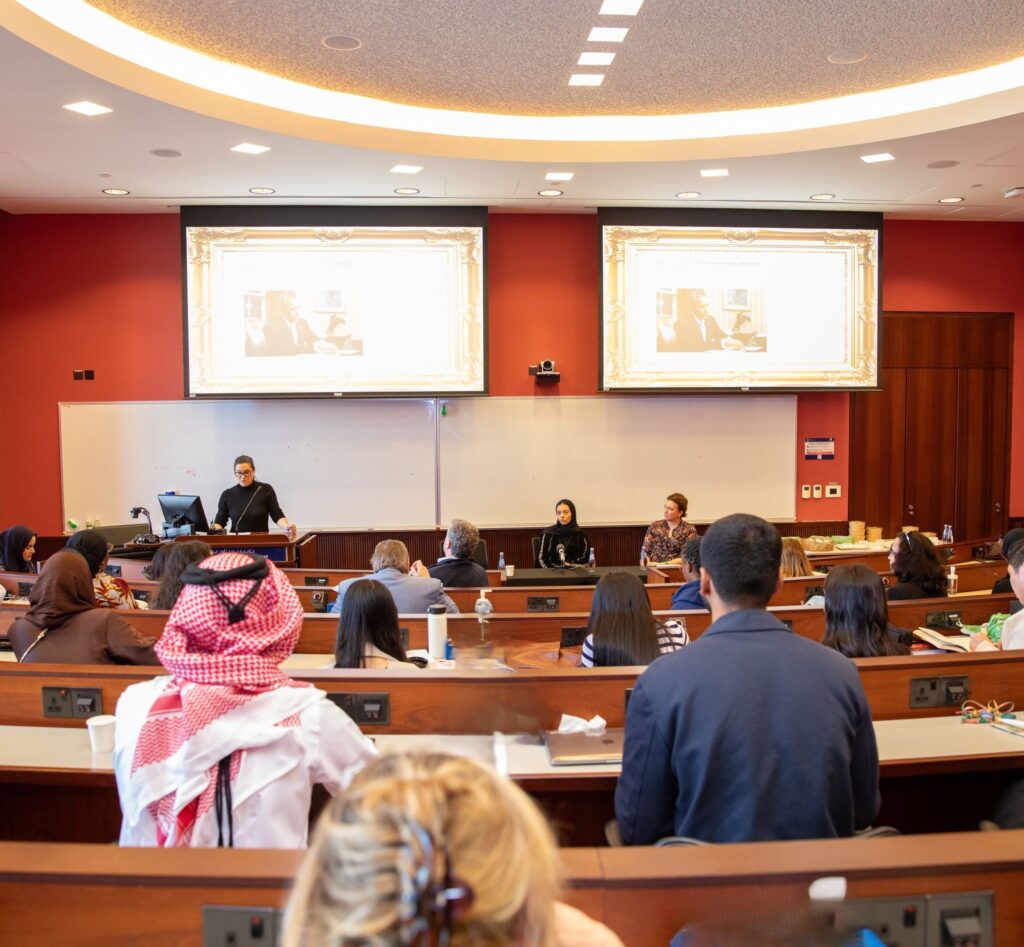
The Certificate in American Studies (CAST) asks students to consider the complex and multifaceted factors that shape American experiences, broadly construed–particularly by emphasizing the transnational contexts in which these experiences emerge.
The multi-disciplinary program provides students with an understanding of the historic development of American peoples, societies, and institutions. It explores political, cultural, economic, religious, and social themes across a variety of disciplines. It also seeks to understand North America within a global context – asking students to think not only about how Americans have shaped the world, but also how the world has shaped them.
Students take core courses in American Studies, focusing on government, history, culture, and literature, that examine the thought, communications, and behavior that have shaped society in North America. Students then select appropriate elective courses that match their specific interests. Finally, under the direction of a faculty member, each student writes a senior research thesis or produces an e-portfolio that organizes and focuses their studies.
CAST Application Process
GU-Q students must complete the CAST application form and contact program advisor Elizabeth Wanucha by the posted deadline.
- Application Deadline: The application period for 2025-2026 is open. The deadline to apply is March 25, 2026.
- Eligibility: Applications are open to rising sophomores and beyond, provided you can show evidence that you can complete the program prior to graduation.
Program Goals
As an interdisciplinary program, American Studies:
- Enables students to make connections across diverse fields of inquiry
- Facilitates cross-disciplinary connections and consolidates study in an area of interest
- Exposes students to theoretical, analytical, and methodological approaches from diverse perspectives, including cultural studies, history, the humanities, and the social sciences
Program Administrators

Dr. Sarah Gaultieri
Curricular Chair

Dr. Valentini Pappa
Faculty Liaison

Elizabeth Wanucha
Student Advisor
CAST Certificate Requirements
Course Requirements and Electives
Requirements:
- One of the following US history courses: HIST 1801: United States History to 1865, or HIST 1802: United States History since 1865, or HIST 2301: US Diplomatic History II.
- GOVT 1200: US Political Systems
- One class designated as either HALC or AMST focusing on American Literature & Culture (or otherwise approved by the CAST curricular committee)
- A minimum of three elective courses of choice, which have been designated as applicable for the American Studies program.
- Completion of an original research thesis or ePortfolio
Sample Elective Courses
- ECON 4411: Economics/Strategy of Sport
- ENGL 2750: Cultural Politics of Migration
- GOVT 3240: Campaigns and Elections
- HIST 3609: America and the Muslim World
Final Research Thesis or ePortfolio
Students must complete a thesis or electronic portfolio. Students also taking Honors in the Major must complete their CAST thesis in their junior year; however, if they choose the portfolio option, Honors in the Major students may also pursue CAST in their senior year.
Thesis Option
The research thesis enhances and advances the student’s research interests and skills and is undertaken under the supervision of a faculty mentor.
Thesis Requirements
- Must have a faculty mentor
- Students can elect to revise and expand the thesis project previously undertaken as part of a seminar
- The thesis must be reviewed and approved by the American Studies faculty for the Certificate to be awarded
- The student must give a formal seminar attended by all American Studies faculty in residence during the spring semester in which the thesis is completed
- The expected length of the thesis is 25-30 double-spaced pages, including references and endnotes. The submitted thesis will receive a Pass/Fail grade and not a letter grade
ePortfolio Option
The ePortfolio is a cumulative project that encourages students to reflect on the work they have done in the program, and is a foundation for creating the reflective essay and oral presentation. The ePortfolio will serve as an online repository for student organization and learning, and for advisor mentoring and monitoring. On the student end, it visually organizes and stores CAST materials and facilitates reflection, interdisciplinary and experiential connections, and critical evaluation. On the faculty side, it facilitates student-advisor interaction and monitoring of progress.
Grading is pass/fail, based on completion of the basic checklist, as well as a reflective essay. A committee appointed by the CAST faculty chair will grant a certificate upon evaluation of the student’s eportfolio, reflective essay, and oral presentation.
ePortfolio Requirements
- Portfolio: Using the provided ePortfolio platform, include the following for each of the six required courses:
- A representative/culminating written work
- Any selected relevant artifacts (e.g., videos, images, presentations, etc.); and
- A 500-word reflective essay on the experience of the course as part of the certificate. The reflective essay should make connections between disciplines, and to personal experiences, and demonstrate a critical evaluation of these connections. It should show reflection and self-assessment, and be clearly organized and well-written
- Meetings: At least one meeting with their mentor per semester, documented using the “mentor supervision form,” including feedback and next steps
- Activity: One (minimum) co-curricular enrichment activity (e.g. lecture, workshop, field trip, etc.) relevant to certificate attendance/participation, followed by a written reflection describing the activity’s connection to the certificate
- Presentation: Oral Presentation of ePortfolio required in senior year (15 minutes followed by a question and answer section)
Portfolio Reflective Essay Rubric (Benchmark)
An excellent ePortfolio has the following characteristics
- Interdisciplinary Connections: Independently synthesizes or draws compelling conclusions by combining examples, facts, or theories from a variety of subject areas in the field of American Studies.
- Connections to Experience: Meaningfully synthesizes connections among experiences outside of the formal classroom (including workshops, speaker series, etc.) to deepen understanding of fields of study, to illuminate concepts, theories, or frameworks of fields of study, and to broaden own points of view.
- Critical Evaluation of Connections: Thoroughly (systematically and methodically) analyzes and carefully evaluates the relevance of disciplinary concepts or theories to interdisciplinary contexts. Identifies the advantage of interdisciplinary research.
- Reflection & Self Assessment: Recognizes and evaluates changes in own learning over the course of certificate/minor, recognizing contextual factors (e.g., interdisciplinarity, importance of analyzing context from multiple perspectives, etc.) that have shaped those changes. Examines how the course contributes to personal and intellectual growth and development.
- Organization & Style: Writing is flawless (grammar, spelling, coherence, flow), the argument is original, well-organized and clear, demonstrating a superior ability to creatively and appropriately organize and express ideas.
Thesis Deadlines for 2025-2026
- October 5, 2025: Progress report due to respective mentor(s) (mandatory)
- January 11, 2026: Thesis/eportfolio draft due to respective mentor(s) (mandatory)
- March 1, 2026: Final thesis/eportfolio due to respective mentor(s) (mandatory)
- March 7, 2026: PowerPoint presentation slides due for Certificate presentation
- Mid-March 2026 (exact date TBD): Certificate Project presentations (mandatory)
- March 31, 2026: Final thesis/eportfolio Due to Committee Members (note: Junior-year students completing their CAST capstone thesis or e-portfolio must meet the same deadlines as seniors, including the March 31, 2026, submission date)
- March 31, 2026: CAST applications due for Juniors and Sophomores wishing to pursue Honors
Notes On Program Planning
- If a student receives advanced credit for American Government, American History and/or American Literature, the student will take upper-level American Studies electives in place of the core foundation courses, as approved by his or her primary academic advisor for the American Studies Program.
- Two American Studies certificate courses may be completed at academic institutions other than Georgetown University with prior approval.
- Eligible students are encouraged to take a Junior Year Abroad, which usually means one semester or two of their junior year on the Washington, DC, campus of Georgetown University.
- Most courses will be completed during junior and senior years
- Students are encouraged to formulate a topic before the beginning of their senior year. Within the first three weeks of the academic year, the student submits to the American Studies Certificate Director a completed and signed thesis declaration form. The student will be expected to submit the revised and final version of the thesis early in the spring semester.
- Students are encouraged to formulate a topic before the beginning of their senior year. Within the first three weeks of the academic year, the student submits to the American Studies Certificate Director a completed and signed thesis declaration form. The student will be expected to submit the revised and final version of the thesis early in the spring semester.

How John Carlos Burog Found His Passion for American Studies
Alumni Spotlight
Born in the Philippines and raised in Qatar, John Carlos Burog’s pursuit of a Certificate in American Studies helped him turn his advocacy to scholarship. His study of historical relationships between cultures for his major in Culture and Politics inspired him to co-found Katipunan, the Society of Filipino Students. “With approximately 270,000 Filipinos in Qatar I felt it was my responsibility to raise awareness of their importance to the region,” he explained.
A semester abroad in Washington, DC, sparked a broader interest in the Filipino diaspora in America: his award-winning Certificate in American Studies portfolio compares experiences of Filipinos/x in America to his own experience growing up in a foreign country. In 2025 he graduated magna cum laude, with plans to pursue futher scholarship on American Studies.