Certificate in Energy Studies
Learn how energy technology, business, and geopolitics are interlinked on a regional and global scale.

This multidisciplinary program provides students with the basic elements of engineering, business, technology, and the political and security aspects of energy, including renewables and natural gas. The curriculum and instruction includes courses from GU-Q, Carnegie Mellon University in Qatar, and Texas A&M University at Qatar/HBKU.
Why study energy?
The development and efficient use of energy resources is critical for economies and societies worldwide. As the energy and natural resources sectors evolve, it is important to understand how technology, business, and geopolitics are interlinked on a regional and global scale.
Learning outcomes
- Understand the importance of the energy industry and markets, the forces that drive them, and how energy impacts our daily lives
- Apply knowledge from the fields of engineering, business, technology and geopolitics to identify trends, strategies, and risks in the energy sector
- Communicate and collaborate to evaluate and integrate diverse perspectives into an analysis that can help drive decision-making
Administrators
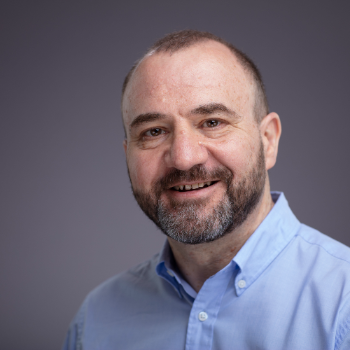
Dr. Rory Miller
Director of Certificate in Energy Studies

Dr. Valentini Pappa
Faculty Liaison

Elizabeth Wanucha
Student Advisor
How to apply
GU-Q students must apply online to the Certificate in Energy Studies (CES) by the posted deadline. The review committee will look at overall grade point average and courses taken as part of the assessment, paying special attention to the application prompts, so make sure they are concise and well-written. The essay must address specific academic areas of interest and how those interests connect to the certificate.
- Application deadline: October 1, 2026.
- Eligibility: Applications are open to students in their second and third years.
Requirements
Course requirements
To receive a certificate, students must take six courses and complete and present a senior capstone ePortfolio project or a thesis. Note that in the certificate programs, only two courses may double-count with your major.
- 5 Courses from GU-Q
- 1 Course from CMU-Q or TAMU-Q/HBKU
- Capstone: Senior capstone ePortfolio/thesis on a specific theme
- Presentation: A public presentation of your capstone digital research project
Sample courses
Once accepted to the program, students will be notified of eligible courses for registration and cross-registration. The courses listed below are examples. The course offerings will vary each semester. Students must discuss their graduation strategy with the program director and student advisor to successfully complete the program.
GU-Q
- Energy Geopolitics
- Energy, Strategy, and Strategic Planning
- The Science of Energy
- Global Energy Transition
- 24 hrs Sustainable Energy
- International Political Economy
- Politics and Society in the Gulf
- Political Economy of the Gulf
- Energy Policy in the Middle East
- Gulf Security: Contemporary Era
- Qatar, Energy Security and Strategic Planning
- Problems in US Energy History
Capstone
ePortfolio
The ePortfolio is a cumulative project that encourages students to reflect on the work they have done in the program as a whole. It serves as an online repository for student organization and learning, and for advisor mentoring and monitoring. On the student end, it organizes the students’ interdisciplinary and experiential connections throughout the Energy Studies Program, and fosters reflection and critical evaluation. On the faculty side, it facilitates student-advisor interaction and monitoring of progress.
The capstone ePortfolio is done throughout the student’s learning trajectory in the CES certificate program and finalized in the senior year. It is graded on a pass/fail basis.
ePortfolio Requirements
- Documentation of each of the six courses taken for CES: For each course taken, create a documentation file that includes a description of the course, relevant media images, at least one representative written work produced for the course, and a 300-word written reflection on the experience of the course as it relates to the certificate.
- Capstone project: Complete a digital research project on an energy studies topic chosen in consultation with a faculty mentor and CES field chair. The capstone project should include visual infographics, images, digestible headers and paragraphs to visually categorize the research findings, hyperlinks to further information and references, and video and audio clips of the student describing the project (see C). For further guidelines, see the detailed eportfolio rubric below.
- Video narrative presentation of the capstone project: Develop a 15-minute video narrative describing the capstone project findings as well as personal reflections on the CES journey. The video can show the student talking about the project, provide a voice-over narration of the project visuals, or combine both approaches.
- Essay: Write a final reflective essay (1500-2000 words), which considers the interdisciplinary connections between classwork, concepts, and experiences acquired through CES. The reflective essay not only establishes connections but also demonstrates a critical evaluation of these connections and self-assessment in a clear, well-written and organized prose. For further guidelines, see the detailed essay rubric below.
- One (minimum) co-curricular enrichment activity reflection: Attend a relevant lecture, workshop, field trip, student club activity, webinar, or conference panel and write a 500-word reflection describing the experience and its connection to the certificate and/or the capstone project.
- Abstract: Students must write a concise abstract of 150-200 words that summarizes the capstone project and provides readers with a clear overview of its purpose, scope, and key insights. The abstract should briefly introduce the chosen energy topic, outline the central research question or problem, and describe the methods or approach used in the project. It should highlight the most important findings or arguments and explain their significance within the broader field of energy studies. The abstract must be written in clear, accessible language and stand on its own as a snapshot of the project’s contribution. No citations, quotations, or detailed background information should be included. The goal is to provide a focused, well-structured summary that helps readers quickly understand what the project investigates, how it was conducted, and why it matters within the context of the Certificate in Energy Studies.
- Public presentation of the capstone project: Deliver a 10-minute presentation open to all GU-Q students on the designated CES capstone presentation day.
Example
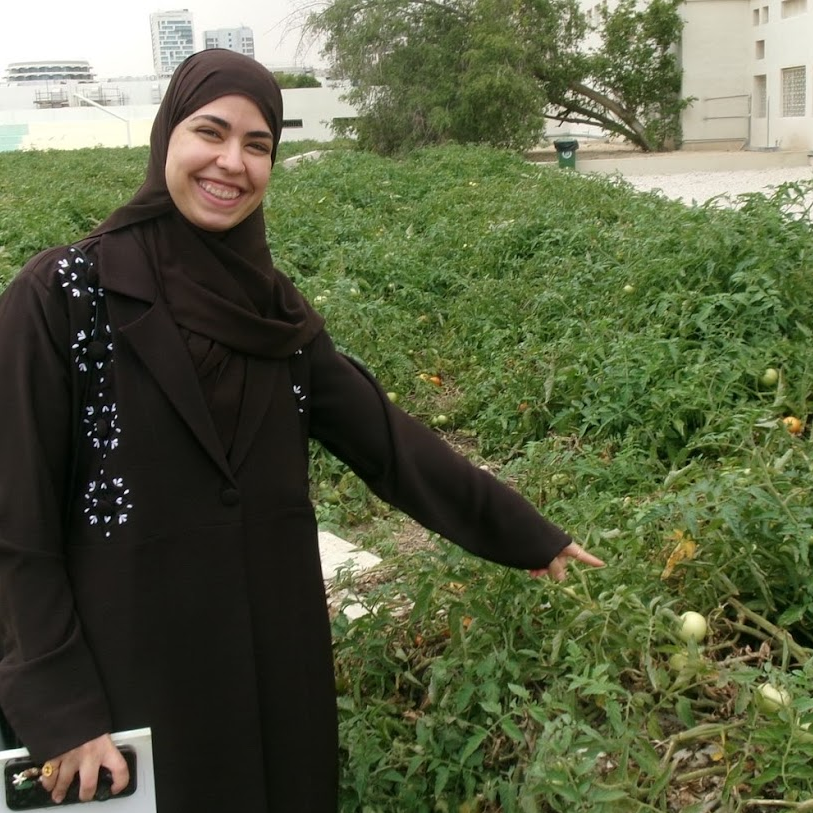
The Interconnectedness of Energy
Noor Ahmed, Class of 2026, produced a mind map as part of her portfolio to demonstrate her key takeaway from the program: the interconnectedness of energy solutions.
“It centers around the many problems Qatar has been facing in achieving food security, especially after the blockade in 2017.”
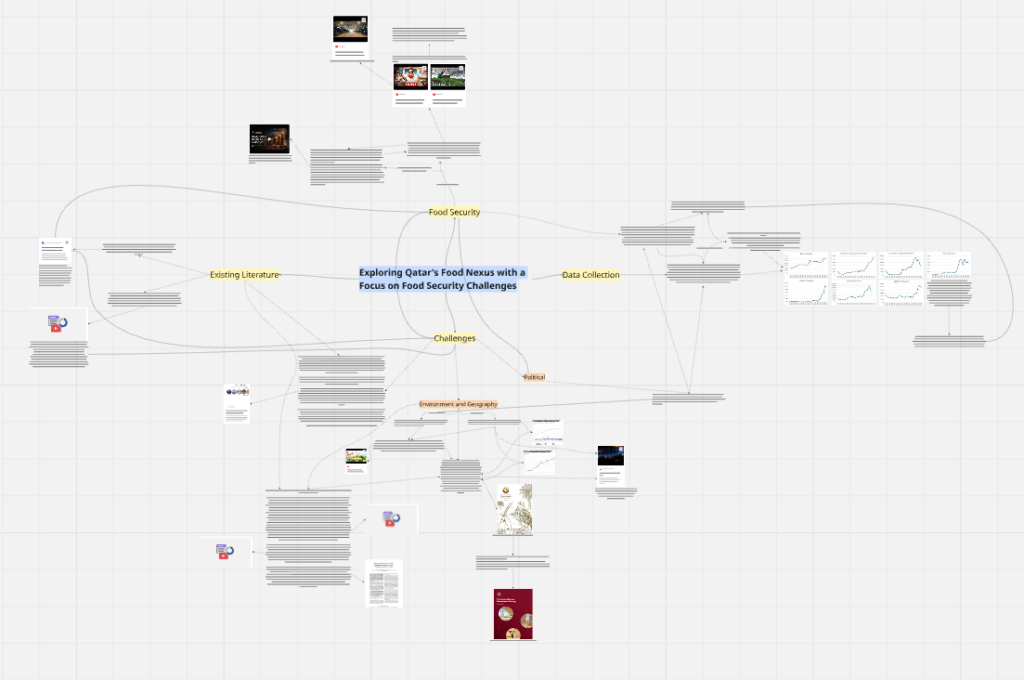
Capstone project: Qatar’s Food Security Mind Map
Thesis
GU-Q students pursuing the Certificate in Energy Studies can opt to write a 25-30 page research thesis (including an abstract) on a topic related to energy, under the supervision of a faculty mentor. It is graded on a pass/fail basis.
Students can elect to revise and expand a paper undertaken as part of a previous course. It should demonstrate a significant transformation of the original project by applying a new theoretical framework, employing a different method, introducing new primary or secondary sources, collecting new data, or reframing the research question. Students are expected to discuss the scope and direction of the thesis with their faculty mentor early in the process.
The completed thesis must be reviewed and approved by the faculty mentor before it can go for evaluation by a CES faculty committee. It must include the following:
- Video narrative presentation of the thesis: Submit a formal digital narration / oral presentation of the thesis during the spring semester in which the thesis is completed.
- Abstract: Write a concise abstract of 150-200 words that summarizes the capstone project and provides readers with a clear overview of its purpose, scope, and key insights. The abstract should briefly introduce the chosen energy topic, outline the central research question or problem, and describe the methods or approach used in the project. It should highlight the most important findings or arguments and explain their significance within the broader field of energy studies. The abstract must be written in clear, accessible language and stand on its own as a snapshot of the project’s contribution. No citations, quotations, or detailed background information should be included. The goal is to provide a focused, well-structured summary that helps readers quickly understand what the project investigates, how it was conducted, and why it matters within the context of the Certificate in Energy Studies.
- Public presentation of the capstone project: Deliver a 10-minute presentation open to all GU-Q students on the designated CES capstone presentation day.
Example
“The Economics of LNG Transition: The Case of Qatar,” by Maryam Almohannadi, Class of 2026
“Translating Singapore’s Integrated Food–Energy–Water Governance to Resource-Scarce States: Lessons for Qatar,” by Mahwash Sarwari, Class of 2026
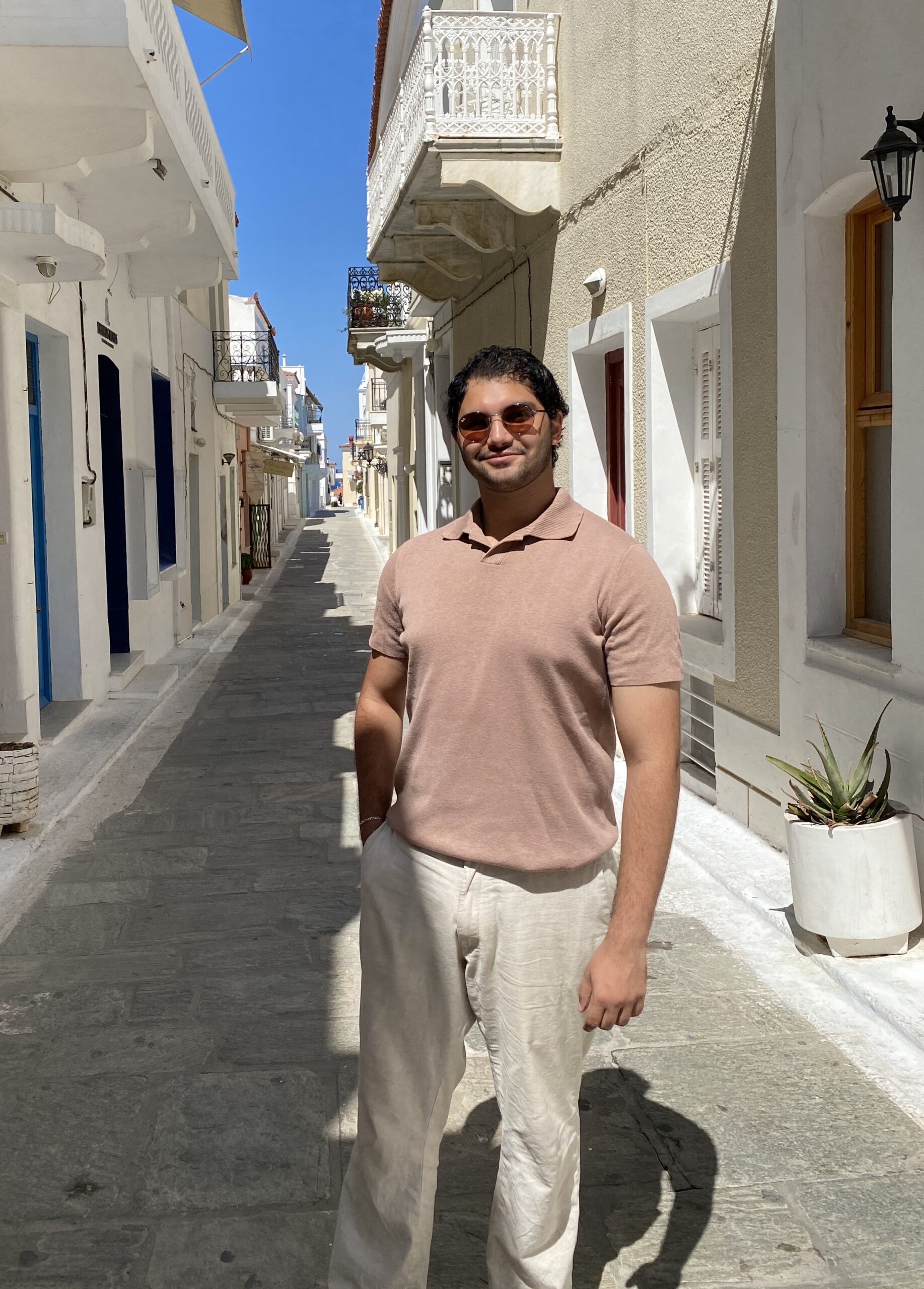
Student Spotlight
Understanding Jordan’s energy and water challenges
International Politics Major Lo’ay Ramadan, Class of 2027, chose the Certificate in Energy Studies to better understand energy resilience and sustainability challenges in the Middle East, particularly in Jordan. His interest was sparked by Jordan’s high dependence on energy imports and severe water scarcity. Learning trips to study climate change policy and land use practices in Greece and Indonesia helped focus his interests and developed a love for research. Now working on a thesis exploring the intersection of energy security and political economy in the Middle East, he says “My research allows me to bring together different disciplines in a way that feels both meaningful and dynamic. The certificate has clarified my passion for working at the intersection of policy, sustainability, and global development, reinforcing my commitment to research and impact-driven work.“