Certificate in Arab and Regional Studies
Benefit from Qatar’s central location to study the current issues of the Arab world through a historical lens, and dive into the cultural factors shaping the region’s relationship with the world.

The Certificate of Arab and Regional Studies (CARS) provides students with a broad interdisciplinary understanding of the Arab and Islamic worlds.
Learn how the internally diverse set of societies of this region have been shaped by both long-term historical processes and contemporary transformations.
Develop the analytic tools and frameworks to closely engage with regional perspectives within transregional and global contexts to understand the forces shaping governance, transformation, and cultural production across the region.
CARS Application Process
GU-Q students must complete the CARS application form and contact program advisor Elizabeth Wanucha by the posted deadline. An information session is offered in January.
- Application Deadline: The application period for 2025-2026 is open. The deadline to apply is March 25, 2026.
- Eligibility: Applications are open to rising sophomores and juniors, provided you can show evidence that you can complete the program before graduation.
Program Goals
As an interdisciplinary program, Arab and Regional Studies aims to:
- Provide students with a rigorous interdisciplinary understanding of the Arab and Islamic worlds drawn from history, political science, economics, anthropology, and cultural studies.
- Develop regionally grounded expertise in the interconnected histories and cultures of the region.
- Train students to apply multiple disciplinary frameworks to regional case studies.
- Cultivate proficiency in the interpretation and critical evaluation of specific historical events, political processes, social transformation, or cultural phenomena.
- Enable students to situate regional dynamics within broader comparative and global frameworks.
- Support the completion of a faculty-mentored capstone research project that synthesizes interdisciplinary learning and demonstrates methodological rigor.
Program Administrators

Dr. Firat Oruc
Curricular Field Chair

Dr. Valentini Pappa
Faculty Liaison

Elizabeth Wanucha
Student Advisor
Zain Fanik
Alumni Spotlight
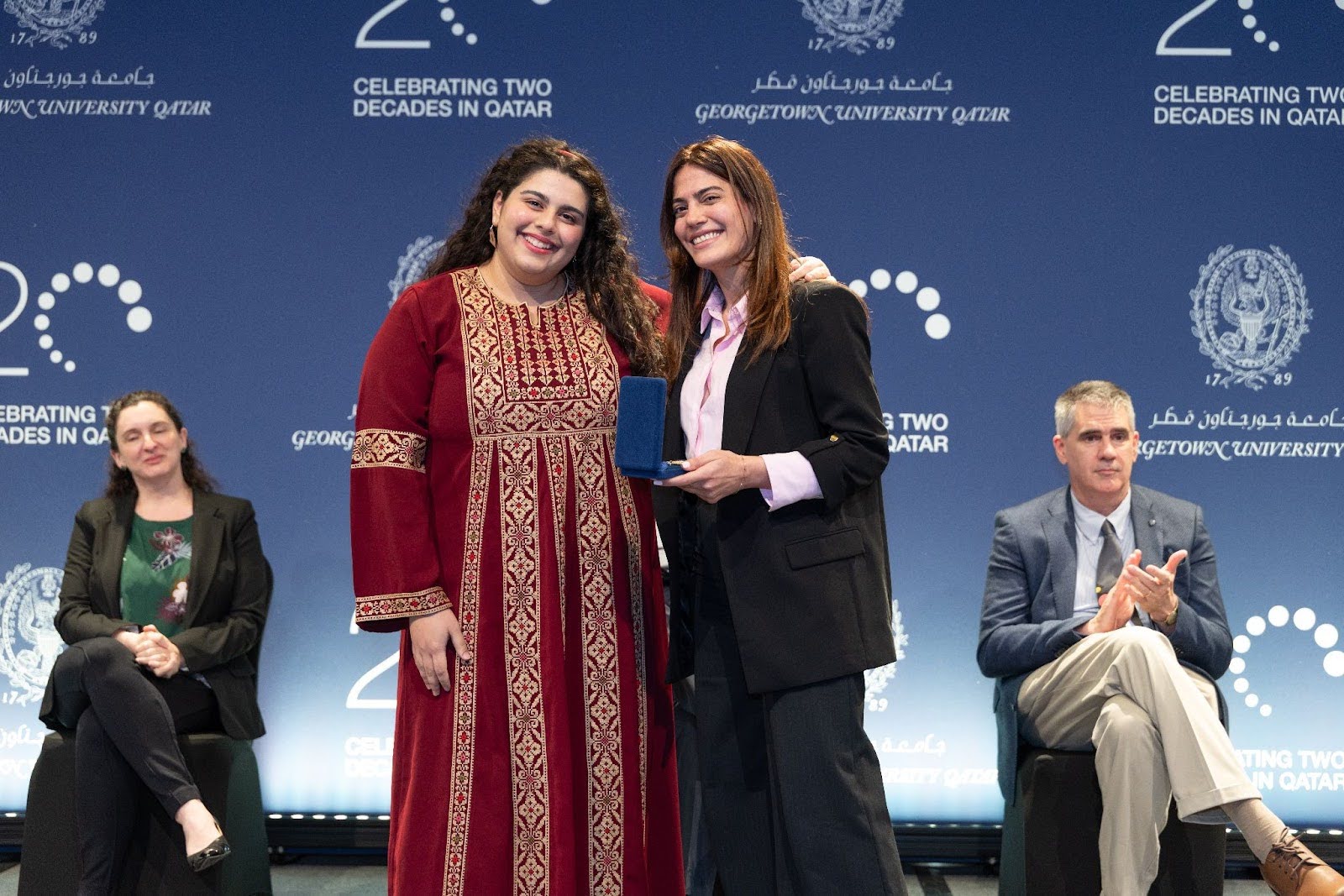
For Zain Fanik (GU-Q ’25), CARS offered engaging coursework mixed with rigorous academic research, allowing her to engage deeply with questions of diversity, identity politics, and minority experiences in the region. Zain’s interest in Arab Christians, refined through sustained mentorship and research, led to a thesis on Palestinian Christians in the West Bank, earning her the CARS Outstanding Research Award.
“The Certificate of Arab and Regional Studies was incredibly rewarding—it gave me a real taste of what academic research looks like and allowed me to explore the region through perspectives I hadn’t considered before.”
Certificate Requirements and Timeline
CARS Requirements
- Courses: Six approved courses addressing the history, politics, societies, and cultures of the region. Most courses will be completed during junior and senior years and are distributed as follows:
- Two gateway history courses, providing foundational historical perspectives
- One course on contemporary regional politics, focused on modern political institutions, processes, or challenges
- One social science course, examining regional dynamics through disciplines such as sociology, anthropology, or economics
- One humanities course, engaging cultural, intellectual, or historical production in the regional context.
- One additional elective course, selected from any discipline and approved for the certificate.
- Certificate Thesis or ePortfolio: In addition to coursework, students must complete a substantial, faculty-mentored certificate thesis or ePortfolio as a capstone project.
- Note: Students cannot pursue honors in the major and a certificate simultaneously, due to the heavy workload. Students who wish to do both must complete the certificate thesis in the junior year as specified in the CARS deadlines.
Arab and Regional Studies Sample Electives
GU-Q offers a variety of courses that fulfill the requirements of the Arab and Regional Studies certificate. Below are some recently offered elective courses:
- ANTH 2233: Qatari Ethnography
- ARAB 3320: Arab Film
- ARAB 4403: Islam & Arab Culture in the Golden Age
- ARAB 4466: The Contemporary Arabic Novel
- CULP 3280: Arabian Nights in Western Literature
- CULP 3285: Film and Visual Culture in the Gulf
- GOVT 4417: Politics and Society in the Gulf
- GOVT 4420: Comparative Politics of the Middle East
- HIST 3610: Women and Gender in the Middle East
- INAF 3257: Media in the Middle East
Thesis or ePortfolio
The Thesis Option
Students pursuing the Certificate in Arab and Regional Studies (CARS) may complete a faculty-mentored research thesis as the capstone requirement of the certificate. The thesis should be a substantial, original research project (approximately 25–30 pages or 7500-9000 words, including footnotes and bibliography) focused on a topic related to the Middle East, North Africa, and Southwest Asian region
Students may build the certificate thesis on a paper previously written for a course. However, the thesis must go well beyond a revision or expansion of earlier work. It should demonstrate a significant transformation of the original project by applying a new theoretical framework, employing a different method, introducing new primary or secondary sources, collecting new data, or reframing the research question. Students are expected to discuss the scope and direction of the thesis with their faculty mentor early in the process.
The ePortfolio Option
Students pursuing the Certificate in Arab and Regional Studies (CARS) may choose to complete an ePortfolio instead of a written certificate thesis. The ePortfolio is a faculty-mentored, curated website that brings together coursework, research, and co-curricular engagement across the certificate. The ePortfolio must include the following components:
- Coursework Showcase: For each of the six certificate courses, students must include:
- A brief course description with a relevant visual
- At least one representative written assignment
- A 300-word reflection explaining the course’s contribution to their understanding of Arab and Regional Studies
- Capstone Project (Digital Research Project): Students must complete a faculty-mentored digital research project on a topic related to Arab and Regional Studies. The project should use appropriate digital tools (e.g., visuals, structured text, hyperlinks, audio/video) to present research findings and demonstrate regional engagement, analytical rigor, and effective digital communication.
- Co-Curricular Enrichment Reflection: Students must complete at least one relevant co-curricular activity (e.g., lecture, workshop, field visit, or conference panel) and submit a 500-word reflection connecting the experience to the certificate and/or capstone project.
- Final Reflective Essay (1,500 words): Students must submit a final reflective essay synthesizing interdisciplinary learning across coursework, research, and experiences, with emphasis on thematic connections and intellectual growth rather than course-by-course summary.
- Video Narrative Presentation: Students must produce a 15-minute video presentation introducing the ePortfolio capstone project and reflecting on their overall learning journey in CARS.
CARS Thesis and Application Timeline
Students completing the CARS capstone project should adhere to the timeline below. Note that students accepted into Honors in the Major may not complete a CARS certificate thesis during the same academic year; however, they may complete the CARS ePortfolio while working on their Honors in the Major thesis.
If the project involves humans, one must complete the IRB protocol for research involving human subjects before conducting research. Learn more about this protocol and approval process.
- Summer (prior to the project year): Initiate background research and begin developing the CARS capstone project.
- October 1: Submission of an extended abstract, brief progress report, and preliminary bibliography to the faculty mentor and the CARS Chair.
- November 15: Submission of an early draft of the project to both the faculty mentor and the CARS Chair.
- December 1: Faculty mentor provides written feedback to the student and submits a brief progress approval note to the CARS Chair.
- February 15: Submission of the second draft of the project to both the faculty mentor and the CARS Chair.
- March 1: Deadline for the faculty mentor to determine whether the project is approved to proceed to final submission and public presentation.
- Mid March: Public presentation of the capstone project (date to be confirmed and aligned with Honors in the Major presentations)
- April 1: Final capstone project submitted to the faculty mentor and CARS Chair.
- April 15: The CARS Review Committee communicates its final decision to the student.