To Be a Desert Hoya When the Sky Was Not Quiet
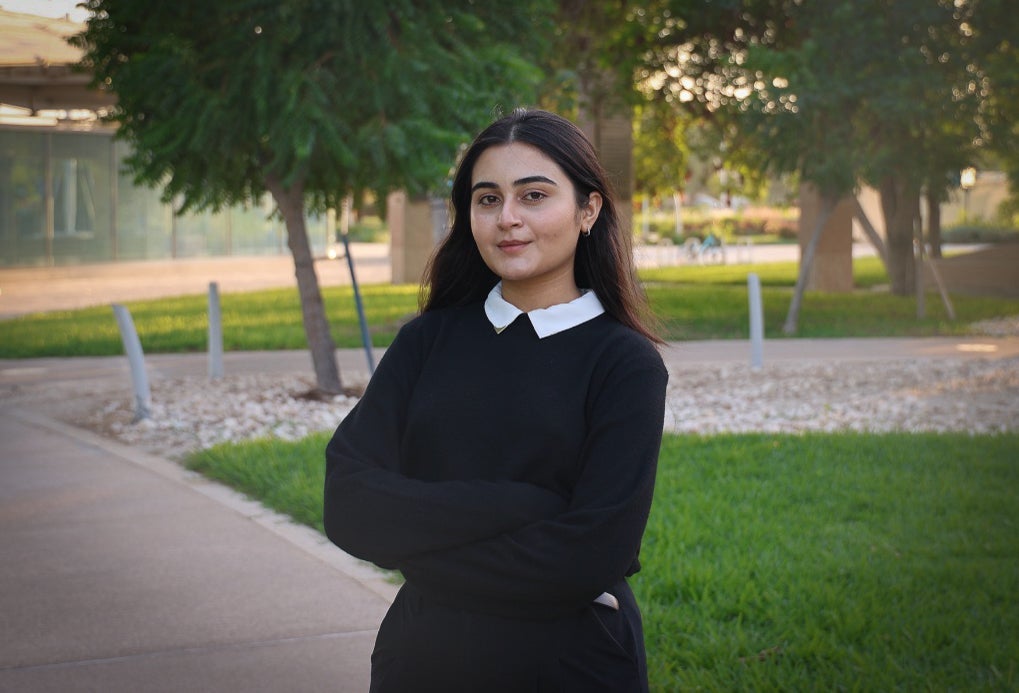
Zarrish Ahmed, a recent graduate at Georgetown University in Qatar, reflects on finding home, holding still, and being held by a community during a regional crisis that tested everything except her love for Doha.
I landed in Doha late at night on the 27th of February, returning from a university trip to Ghana where we had celebrated the 100th anniversary of Black History Month. As the plane descended and the glittering skyline of West Bay came into view, I felt tears fill my eyes. Not from exhaustion. From love. That is what Doha does to you when it becomes home.
I had a full week ahead. A History paper to finish. A poster due for my Race in International Relations class. As President of the South Asian Society, I had planned an Iftar, a Suhoor, and a cricket night for the community. Ramadan had already started and the energy was building. Life at GU-Q felt full in the best possible way.
Then everything stopped.
Israel and the United States bombed Iran. Iran responded by striking US assets and bases across Gulf countries. Qatar, the home of Desert Hoyas, was one of them.
I remember the first night clearly. I could hear missile interceptions somewhere above the city. I sat with that sound for a moment, waiting to feel afraid. The fear never came. I have a deep and unshakeable faith in God’s protection, and in that moment it held me completely. Around me, people were stocking groceries, calling their families, moving away from windows. I understood. I just could not bring myself to leave my bed, which sits right next to the window. I still took my late night walks to the student center and comforted myself with coffee. I held on to my routine like it was a quiet act of defiance.
Then came Tuesday.
In one of the most unique classes I have taken at GU-Q, taught by Dean Safwan Masri, something shifted. In the middle of everything, Dean Masri walked in and shared his email with us in real time, before it even went out to the wider community. That level of transparency, that genuine care for the students sitting in front of him, left me completely still. This was not crisis management. This was a human being showing up for other human beings. I sat there in awe.
Shortly after, GU-Q announced voluntary departure assistance for students who wished to leave the country. It was not a small decision. The university applied for Saudi visas on our behalf, arranged travel logistics, and made sure no one was navigating the uncertainty alone. One by one, the people I knew began to leave. My flatmate, assuming I would follow soon, packed up and left too. And just like that, I was by myself.
I did not want to leave.
Doha is home. Not a temporary home, not a convenient home. A home I chose, a home that chose me back. I kept thinking about those tears on the plane from Accra, how the sight of West Bay made my chest ache with belonging. With missiles being intercepted overhead, not for a single moment did I feel like I needed to be anywhere else.
What kept me grounded was people.
GU-Q made sure students who stayed had weekly data packages so we could attend classes and stay connected with our families. But beyond the institutional, there were individuals who showed up in ways I will never forget. Samreen Khan, Economics Support Manager at the Office of Academic Services, checked in on me every single day I remained in Qatar. Every. Single. Day. Not as a formality, but because that is who she is. She was on the front lines of making sure student staff felt seen and supported, and she did it with a warmth that made the distance from home feel smaller.
And then there was the flight.
My Saudi land-transit visa did not come through. But Qatar Airways opened a few special flights out of Doha, and GU-Q’s voluntary departure assistance meant I had a lifeline. I called the travel office, explained my situation, and Salman Hanif who was overseeing travel operations had what I can only describe as a superhero moment. Within twenty minutes of the flight becoming available, I was booked on the first one to Pakistan. Twenty minutes.
Ever since I joined GU-Q, I have felt supported every single minute. It has always felt like God really loved me, because out of every university I applied to, this is where I ended up. And in the middle of a regional crisis, that feeling did not waver once. It deepened.
On the morning I left, I sat in the back of a car headed to Hamad International Airport and looked out at the city one last time. When my plane lifted off the runway, I felt tears on my face again. The same tears I had cried on the descent into Doha just days before, except this time they carried a different weight. Because this time, a Desert Hoya was leaving home in grief.
But I would be back. Doha does not let go of you easily. And I would not have it any other way.
And I was.
Like many Desert Hoyas who left during that difficult period, I returned to Doha and graduated in person with my classmates.
After everything, we got to say goodbye properly to each other, and to the place that had become home.
“The posts and comments on this blog are the views and opinions of the author(s). Posts and comments are the sole responsibility of the authors. They do not represent the views, opinions or policies of the University.”
The posts and comments on this blog are the views and opinions of the author(s). Posts and comments are the sole responsibility of the authors. They do not represent the views, opinions or policies of the University.
Filed under
Explore more of Desert Hoya
A Letter to Incoming First-Year Hoyas
Congratulations on joining Georgetown University in Qatar! You are now part of the GU-Q community.
What You Need to Know About GU-Q
By Daphne Soriano (GU-Q ’28), an undergraduate student at Georgetown University in Qatar. The fifteen minute break between each class is the best time to go on a walk…