- Desert Hoya
What Georgetown Taught Me to See: A Museum is Not What I Thought
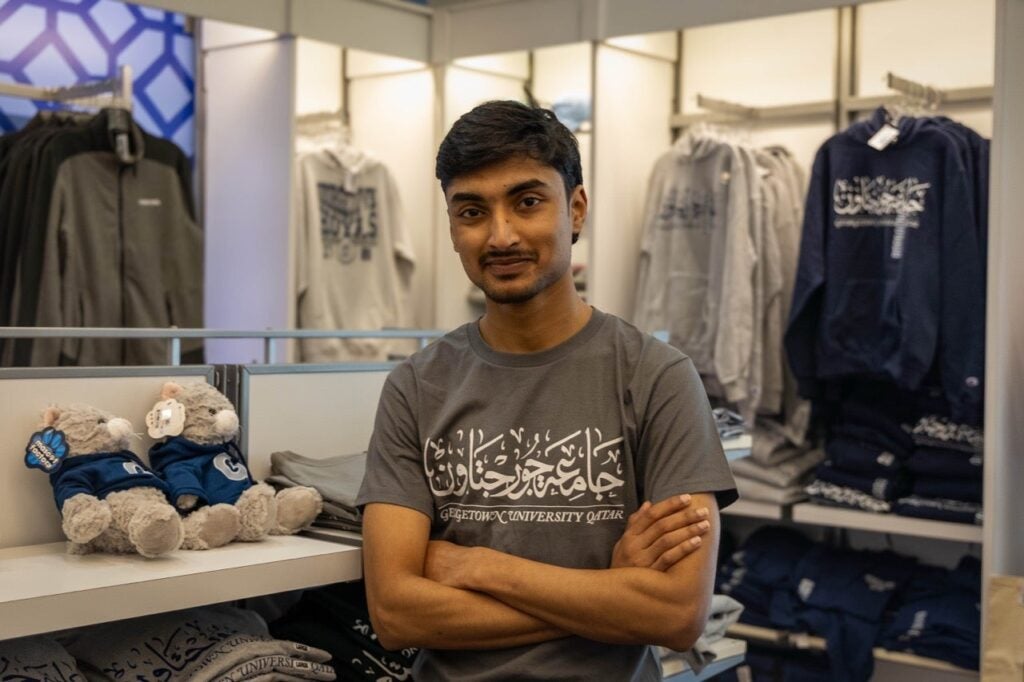
Sazid Hasan is a second year student at Georgetown University in Qatar.
I have always liked museums. However, looking back on my first year at GU-Q, I now feel that liking museums and knowing what to do inside one are two completely different things.
Growing up, whenever I visited a museum, I would walk through the halls with genuine interest. I used to scrutinize the collections at the museum, but my interest was limited to the physical presence of the thing. For instance, when I visited the National Museum in Bangladesh a few years ago and saw Dhakaiya Muslin – the world’s most famous fabrics – I was astounded by the delicacy and craftsmanship. I knew the muslin was a long-gone past, but my curiosity was limited, and I did not ask “Why?” I did not know what I was supposed to be looking for. I liked the idea of museums – years of history, diverse culture, all under one roof – but I did not know how to interact with them.
In my very first week at GU-Q, Iktishaf Qatar – a program run by Student Life dedicated to immersing first years in Qatari culture – took us to the Qatar National Museum. I walked through the exhibits, learned about the history of Qatar, the pearl collection, the history before oil discovery and after, the geography, and the formation of the state. I noticed a few things and read placards, butI did not yet have the language to go deeper than what was written on the walls.
About a month later, Iktishaf Qatar took us again – this time to the Sheikh Faisal Bin Qassim Al Thani Museum. This time, I discovered I was seeing everything with a new vision. By that time, I had taken Prof. Evelyn Alsultany’s one-credit course, Middle East in Hollywood, and my SFS Prosem course on Anthropology with Prof. Rogaia Abusharaf. These courses were dismantling the orientalist narrative inside me – the way the West has historically looked at this region as exotic and backwards, which I was completely unaware of. I found, to my utter surprise, I was beginning to carry those questions with me.
The Sheikh Faisal Bin Qassim Al Thani Museum has vintage cars, religious scripture, ancient weapons, Nazi flags, Islamic manuscripts, Persian carpets, depicting entire world history in thread, under a single roof, and were collected by one man over a lifetime. There I felt as if I were moving through time and place simultaneously, walking through the Silk Road, seeing the soldiers in wars, intricate artwork, and my personal favorite: a collection of a hundred cars from a 1900 Benz Ideal to a 2000 Ford Mustang “Eleanor”. Especially, standing in front of one of the Persian mats, I could not help but think of our Muslin Fabric. The same fabric that I had seen just a few years ago at that museum in Bangladesh. And there I found myself asking a question I had never thought to ask in a museum before: who made this, and what did they believe the world looked like?
I found myself in the pitfalls of numerous questions. I kept thinking about preservation. About why people collect. About what it means to insist that something deserves to be remembered, is preservation and the dire urge to be remembered intrinsic? All my thoughts pivot to one point: why did a man spend his life gathering the fragments of human civilization and why does he now insist on preserving them??
This summer, I came back home to Bangladesh. I took a trip to Rangpur to visit my friend from Northwestern Qatar. With him, I visited the Tajhat Palace – a grand colonial-era palace built in the early 20th century, now a regional museum. A year ago, I would have walked through it, maybe clicking a few aesthetic Instagrammable pictures, the way I always had. I might have admired colonial architecture vaguely, reading placards halfway; however, one thing I know for sure: I would have left without much “thought” for me to carry.
The palace’s architecture is exemplary of Indo-Saracenic architecture, blending European colonial, Mughal, and traditional Bengali styles. This time, I tried to tie the knot between this blending and cultural blending as a Bangladeshi. I found myself thinking about the families who had lived there, the colonial and socio-economic structures that surrounded them, and the history the building itself was trying to hold together. I stood in rooms longer than was necessary, my eyes wide open as if I were inside a time machine and could see the past with my bare eyes!
The important part is that all the staring, being amazed, and questioning came from my agency, which was shaped mostly by GU-Q education in my first year. I am grateful to Iktishaf Qatar for offering us an opportunity to truly discover Qatar. I am grateful to GU-Q for giving me the tools to understand what I was looking at. And I am grateful to myself, in a quiet way, that I always liked museums and history even when I did not yet know how to “see” them.
The posts and comments on this blog are the views and opinions of the author(s). Posts and comments are the sole responsibility of the authors. They do not represent the views, opinions or policies of the University.
Explore more of Desert Hoya
Things Jack and I Learnt in Italy During Study Abroad
Sama Alissa is a senior majoring in Culture and Politics. During my study abroad semester in the Villa Le Balze, I was accompanied by little Jack the Bulldog. Jack…
Contemplation in Action: My Summer Research on the Rohingya Community
Sazid Hasan is a second year student at Georgetown University in Qatar. Every first year student at GU-Q takes a Pro Seminar course in their fall semester, which is…