Arabic Language Program and Minor
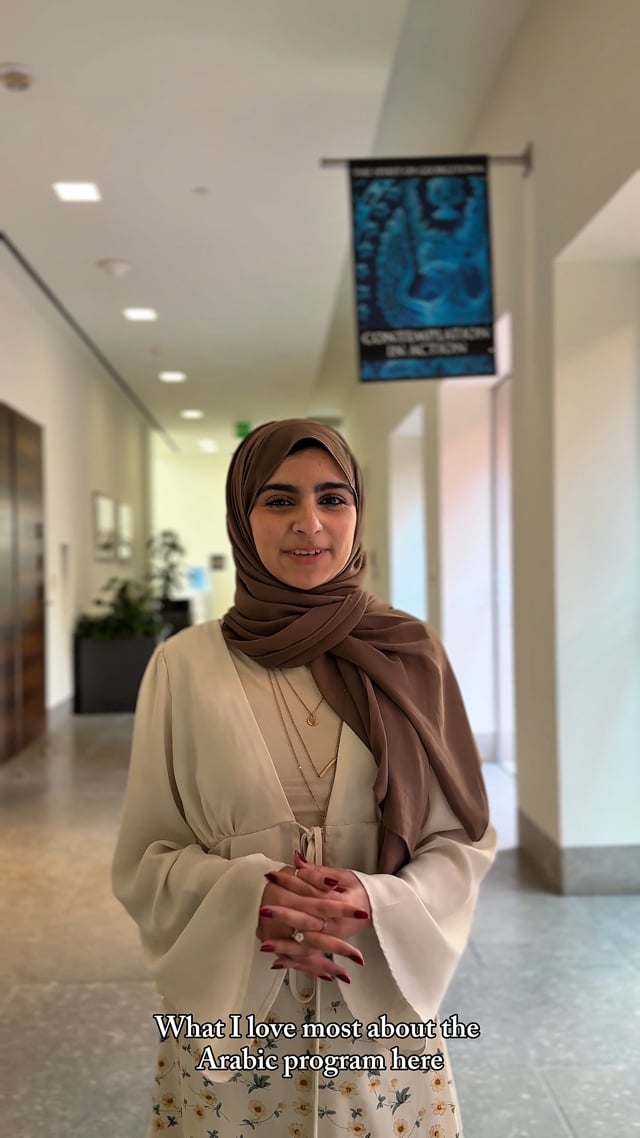
Gain mastery of the Arabic language so you can engage with Arabic-language business, political, and cultural environments.
Quick Links
Overview
Georgetown University hosts one of the strongest university-level Arabic language programs in the world. Building on that tradition, Georgetown University in Qatar is proud to offer a dynamic, innovative, culturally immersive program in Modern Standard Arabic (MSA) tailored to the needs of students in the Gulf region.
Students attain proficiency in Modern Standard Arabic through two distinct tracks tailored to their needs: Arabic as a Second Language or Arabic as a Heritage Language. The program emphasizes the development and application of core skills in reading, writing, listening, and speaking. Students who continue their studies beyond the advanced level in either track have the opportunity to reach the highest levels of proficiency in MSA, enabling them to function effectively in academic, professional, political, and social settings.
Program Administrators

Dr. Youssef Haddad
Director of the Arabic Program

Dr. Valentini Pappa
Faculty Liaison

Ms. Elizabeth Wanucha
Student Advisor
Getting Started
Taking Arabic at GU-Q
- Eligibility: Arabic language courses are open to undergraduate students currently enrolled at GU-Q or one of its partner universities in Education City.
- Cross-Registration: Students from partner universities who wish to enroll in Arabic courses at GU-Q should contact the registrar at their home institution for details about the cross-registration process.
- Placement Test: All students are required to take an Arabic placement test before enrolling in a course. The test determines whether a student should follow the Second Language Program or the Heritage Language Program, and it identifies the appropriate level at which the student should begin.
Declaring the Minor
To declare the minor, review the Arabic minor requirements, ensure that you can complete the requirements for the minor in time for graduation, and then complete the Arabic Minor Declaration Form.
Please note that students may elect to pursue both a minor and a certificate, along with their other graduation requirements, as long as they can complete the requirements for all in time for graduation.
If you have any questions about the minor requirements and your graduation, please consult Elizabeth Wanucha, student advisor for certificates and minors.
Choose Your Minor Track
Language and Culture Track
Ideal for students at the beginning level of proficiency who want to strengthen their Arabic and explore Arabic culture.
The Language and Culture track of the Arabic Minor requires the successful completion of seven courses, in addition to passing the Arabic Language Proficiency Exam. It is particularly well-suited for students who enter GU-Q with little or no prior knowledge of Arabic and are interested in developing their language proficiency and cultural understanding.
Requirements
The specific path to the Language and Culture track of the Arabic Minor depends on students’ placement level and language background.
Language and Culture Track Pathways
Second Language Learners (with no prior background in Arabic) – Students complete the six-course sequence in Modern Standard Arabic, followed by one Post-Advanced Arabic course or a course taught in English on Arabic language or culture. A post-advanced course may be a content- or skill-based, or cover literature and culture or linguistics.
Heritage Language Learners – Students complete the four-course sequence in the Heritage Language track, followed by three Post-Advanced courses in any category. One Post-Advanced course may be substituted with a course taught in English on Arabic language or culture. At least one of the post-advanced courses must be a literature and culture course. The remaining post-advanced course(s) may be content- or skill-based, or cover literature and culture, or linguistics.
Students Placed into Intermediate or Advanced Arabic – Students may count all remaining courses in the sequence, beginning at their placement level, toward the minor. To complete the seven-course requirement, they may then take additional Post-Advanced courses. One Post-Advanced course may be substituted with a course taught in English on Arabic language or culture. At least one of the post-advanced courses must be a literature and culture course. The remaining post-advanced course(s) may be content- or skill-based, or cover literature and culture or linguistics.
Advanced Studies Track
Designed for students entering at the intermediate level or higher who want to deepen their Arabic proficiency.
The Advanced Studies Track of the Arabic Minor requires the successful completion of six Arabic courses at the Advanced and Post-Advanced levels, in addition to passing the Arabic Language Proficiency Exam. This track is particularly well-suited for students who enter GU-Q at the intermediate level or beyond, and who wish to deepen their proficiency in Modern Standard Arabic across a range of skills and topics.
Requirements
All courses must be taught in Arabic.
Heritage Language Track
- ARAB 2227 – Advanced MSA (Heritage Language)
- 2 Post-Advanced (Content-Based, Literature & Culture, or Linguistics) courses
- 2 Post-Advanced, Skill-Based courses
- 1 Experiential Learning course in Arabic
Second Language Track
- ARAB 2216 – Advanced MSA I (Second Language)
- ARAB 2217 – Advanced MSA II (Second Language)
- 1 Post-Advanced (Content-Based, Literature & Culture, or Linguistics) course
- 2 Post-Advanced, Skill-Based courses
- 1 Experiential Learning course in Arabic
Course Substitutions for Students Placed Beyond the Advanced Level
Second Language learners who place out of one or both Advanced MSA courses (ARAB 2216 / ARAB 2217) will substitute each with an additional Post-Advanced course in any category (e.g., Literature and Culture or Skill-Based).
Heritage Language learners who place out of Advanced Arabic may substitute it with an additional Post-Advanced course in any category (e.g., Literature and Culture or Skill-Based)
Curriculum
Curriculum by Program Track
MSA Second Language Program
This program is designed for students who have no prior linguistic or cultural background in Arabic.
- ARAB 1011 & 1012 — Intensive Level 1 MSA, I & II (6 credit hours each)
- ARAB 1111 & 1112 — Intensive Level 2 MSA, I & II (6 credit hours each)
- ARAB 2216 & 2217 — Intensive Level 3 MSA, I & II (6 credit hours each)
MSA Heritage Language Program
This program is designed for students with some colloquial or cultural knowledge of Arabic.
- ARAB 1020 & 1021 — Beginning MSA – Heritage Language, I & II (6 credit hours each)
- ARAB 1122 — Intermediate MSA – Heritage Language (6 credit hours each)
- ARAB 2227 — Advanced MSA – Heritage Language (6 credit hours each)
Shared Curriculum for the Language Program
Post-Advanced Arabic Courses
Upon completion of Level 3/Advanced MSA instruction, students in both the Second Language Program and the Heritage Language Program can continue their language studies in a variety of Post-Advanced topical and thematic courses offered in Arabic. Note that course offerings vary by semester, and some courses have prerequisites.
- Skill-based Courses
- Content-based Courses
Arabic Courses taught in English
Upon completion of Level 1 / Beginning MSA instruction, students in both the Second Language Program and the Heritage Language Program can learn more about Arabic language and culture in a variety of topical and thematic courses offered in English. Note that course offerings vary by semester, and some courses have prerequisites.
- CULP 3289 Cinema in the Arab World
- CULP 3871 Arab Anglophone Women Writing
Arabic Minor Advanced Credit, Transfer Credit, and Study Abroad
No more than three courses from outside of Georgetown (advanced credit, transfer credit, summer, and study abroad) can count toward the minor. If a student has two classes of advanced credit, a year of study abroad, and one transfer class, only three of those five classes can apply to the Arabic minor. Below are the limits for each:
- A student can bring in up to two advanced credit classes to count toward the minor.
- A student can bring in up to one study abroad class to the minor if away for a semester, or up to two classes to the minor if away for the academic year.
- A student can transfer in up to one class toward the minor. Georgetown summer programs that carry Georgetown course prefixes and numbers (excluding study abroad, as noted above) do not count against transfer limits.
Georgetown credit for advanced and transfer language credit is pending language placement. If a student took a year of Introductory Arabic, but then subsequently places into the first year of Introductory Arabic at GU-Q, the student does not receive transfer credit for that year of Arabic taken elsewhere.
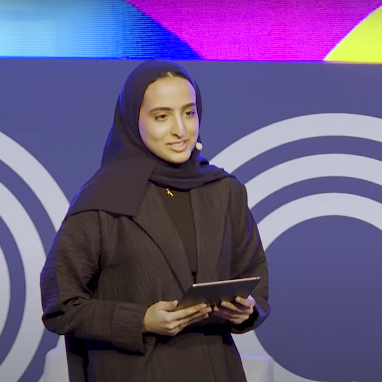
Alumni Spotlight
Moza Al-Hajri, Class of 2026
“I took the Arabic minor because I really enjoyed the class I took for my proficiency requirement. All of the classes I’ve taken are Arabic literature classes at the post-advanced level. You get the same caliber of intellectual conversation that we have in history classes or culture and politics classes, but in Arabic. It’s really nice to see that side of students discussing and talking in the lanuage as well. Many of the opportunities I’ve had at GU-Q were in Arabic, and having this opportunity to speak the language in class helped me to develop intellectually in both Arabic and English contexts.”