Experts examine Israel’s new death penalty law and its unequal application
In 1954, Israel abolished the death penalty for murder. Haim Cohn, the country’s attorney general at the time and later a Supreme Court justice, was among the strongest supporters of the move.
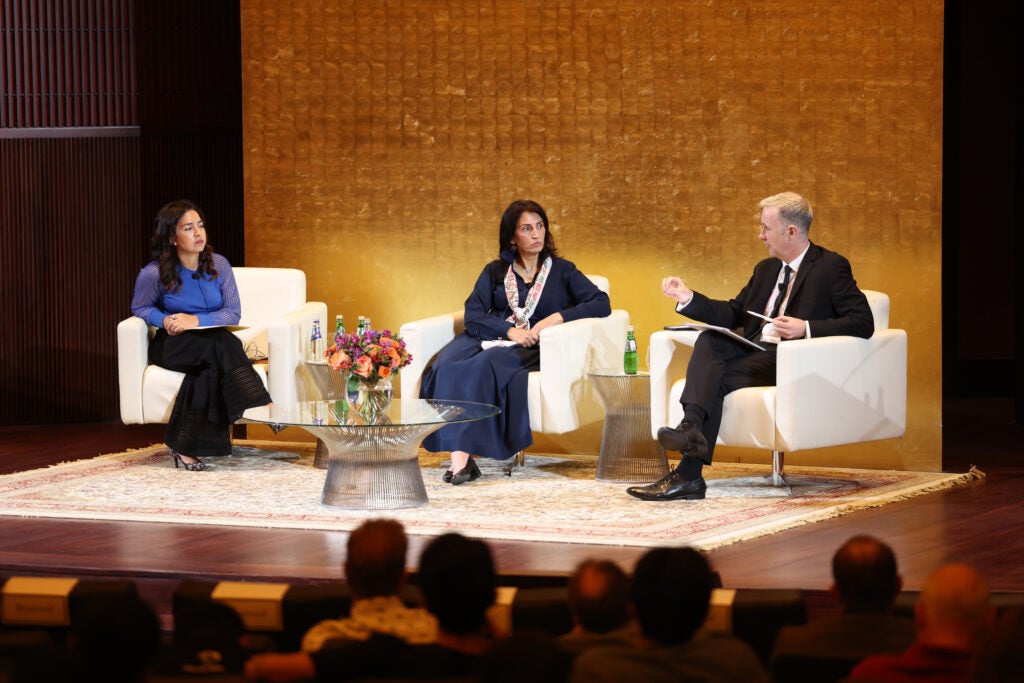
Assistant Professor Noha Aboueldahab (left), Resident Fellow Diana Buttu (center), Visiting Fellow Ralph Wilde (right)
In a 1996 essay on the values of a Jewish and democratic state, Cohn wrote: “The prohibition against harming human life, as a foundational principle of public law, means first and foremost the prohibition against imposing the death penalty. Human life – meaning the life of a murderer or a traitor as well. The fact that a murderer took human life does not justify taking his, neither by the state nor by anyone else.”
Seventy-two years later, the Knesset brought back the death penalty. Experts and human rights organizations say the law will apply in practice only to Palestinians. National Security Minister Itamar Ben-Gvir celebrated its passage with a cake decorated with a noose on his birthday.
For years, Israel’s decision not to use the death penalty was a point of pride, Diana Buttu, a resident fellow at GU-Q and prominent Palestinian lawyer, said at a GU-Q event focused on the law. She recalled former Israeli President Chaim Herzog pointing to the country’s record of not carrying out the death penalty as evidence of its humane approach.
So what changed? That was the question she posed to the audience.
The image factor that the Israeli government was once worried about is no longer existing, they just got more votes this time.
Diana Buttu
The law creates two systems.
In Israel’s civilian courts, it allows a death sentence for someone who intentionally causes a death with the aim of denying the existence of the State of Israel. In the military courts of the occupied West Bank, death becomes the default sentence for a resident convicted of intentionally causing a death in an act of terrorism. Judges can impose life imprisonment only in special circumstances, and a simple majority is enough to impose a death sentence.
The military-court provision does not apply to Israeli citizens or residents. Within minutes of its passage, the Association for Civil Rights in Israel petitioned the Supreme Court to strike it down.
But the law was only the starting point for the event.
Moderated by Assistant Professor Noha Aboueldahab, the discussion brought together Diana Buttu and Visiting Fellow Ralph Wilde to ask a broader question: How is international law applied, and to whom?
Wilde, a professor of international law at University College London and a visiting fellow at GU-Q, argued that the law violates Palestinian rights to self-determination and international prohibitions on racial discrimination. He pointed to the different rules for Palestinians and Jewish Israelis accused of comparable killings: Palestinians can face a mandatory death sentence in military courts, while Jewish Israelis are tried in civilian courts, where the death penalty is not mandatory.
“If one word is to be attached to this law, then that word cannot be ‘terrorists,’” Wilde said. “In truth, it should be called the Death Penalty for Palestinians Law.”
For Buttu, the issue of unequal treatment extends beyond the death penalty law itself. Days before the GU-Q panel, she made a broader argument about the selective application of international law at the U.N. Addressing the Hague Group, a coalition of states formed in January 2025 to support enforcement of rulings by the International Court of Justice and the International Criminal Court, she argued that the concern goes beyond Israel or the death penalty. The larger question, she said, is what happens when international law is applied differently depending on who is involved.
“The greatest threat to international law is not the state that openly defies it,” she said. “The greatest threat is our selectivity – the quiet decision that is made in capitals and rooms that the rules don’t bind everybody, they only bind some. It is the belief that we can excuse some because they are our allies, our partners and our friends.”
Views expressed are those of the speakers.