Can fiction about animal minds help us bridge the human divide? This professor thinks so.
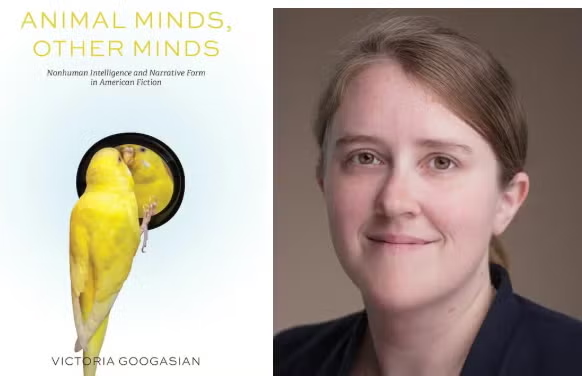
In her new book, Animal Minds, Other Minds: Nonhuman Intelligence and Narrative Form in American Fiction (University of Virginia Press), Victoria Googasian, a professor at Georgetown University in Qatar, argues that literary forays into the minds of animals offer a surprising toolkit for responding to the modern world’s most stubborn ills—from systemic racism to the rise of generative AI.

By analyzing how authors portray nonhuman cognition, intelligence and feeling, Dr. Googasian explores how fiction has experimented with animal characters in ways that can help us to “decenter” our own cognitive styles and see ourselves as a part of an ecology of diverse minds.

“That ability to see beyond ourselves is useful not just for living with other species, but for living with other human beings.”
Resisting racial politics
The book also shows how curiosity about animal minds informed American racial politics for more than a century. Professor Googasian points to Zora Neale Hurston, who used animal minds in her fiction to subvert white supremacy, showing how assertions of a “universal” humanity can sometimes shut down curiosity about others’ thoughts, feelings and experiences.

Hurston in 1946, captured by Carl Van Vechten. Yale Library Collection via Wikimedia Commons
Hurston was a fiction writer and folklorist who transcribed traditional tales and lore such as this collection of stories.
Hurston was also a leader in the Harlem Renaissance
Hurston wrote animal stories as part of an important Black literary tradition in which both animal and Black consciousness remain resistant to white control, Dr. Googasian says.
“Hurston shows us that a belief in so-called universal, legible, common humanity could also be violent and exclusionary. Sometimes embracing the animal qualities of one’s own thinking and behavior can be a way to combat such violent representations.”
Preserving humanity in the age of AI
Professor Googasian’s book tracks the intersections of literature and science from the turn of the 20th century through intellectual developments such as the rise of eugenic thinking in the United States, the advent of cybernetics and the neuroscientific turn. The study of animal minds has long informed the study of artificial life and intelligence and vice versa. Fictional portrayals of animal minds shed light on how to preserve the value of personhood in an age when generative AI is reducing human knowledge to data points and flattening cognitive diversity into a sort of trans-individual consciousness. Where AI regurgitates the familiar, the human imagination remains capable of tackling the unknown.
“Literary fiction has imagined animal minds as a way to combat threats to deep subjectivity—whether from industrial modernity, artificial life, or even neuroscience,” says Dr. Googasian.
“Our enduring fascination with what nonhuman others think and feel suggests that we still care about subjective experience, even when so much of our lives has been taken over by technologies for pattern recognition and repetition of the same.”
Teaching cognitive diversity
For educators, Dr. Googasian’s work offers insight into the classroom as a space for cognitive diversity. “Teaching always requires recognizing that other people don’t think the way you do, trying to be open to those differences and make space for them.” It’s a practice she refined by living and working in Qatar. “Moving to a different country while working on this project certainly confirmed for me the value of decentering one’s own cognitive style,” she says.
Her practice has also been impacted by scholarly exchange with her peers at the university. “This close-knit environment has encouraged me to form interdisciplinary collaborations and to share work with colleagues outside my field, helping me develop projects and interests beyond the book.” Her next project, as part of GU-Q’s Energy Humanities research, explores how games, play activities and even judgements about what makes something “fun” are shaped by extractivist approaches to energy.
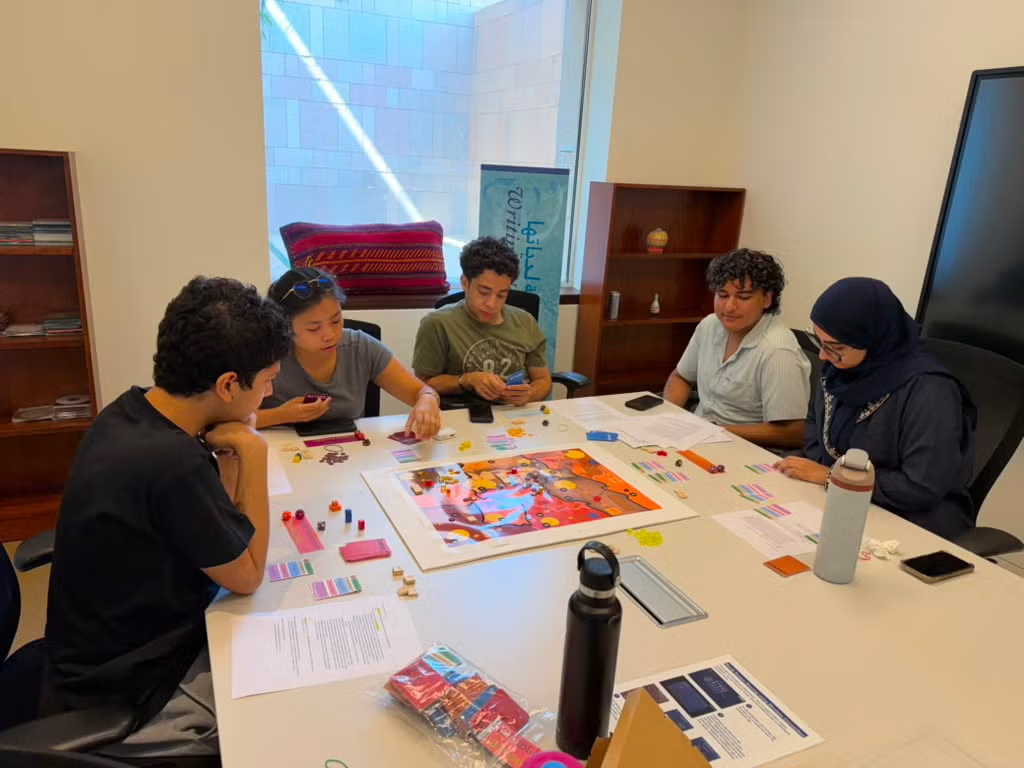
GU-Q students testing game developed by Dr. Googasian
Filed under