How Pakistan brought Iran and the United States to the table — its ambassador to Qatar explains
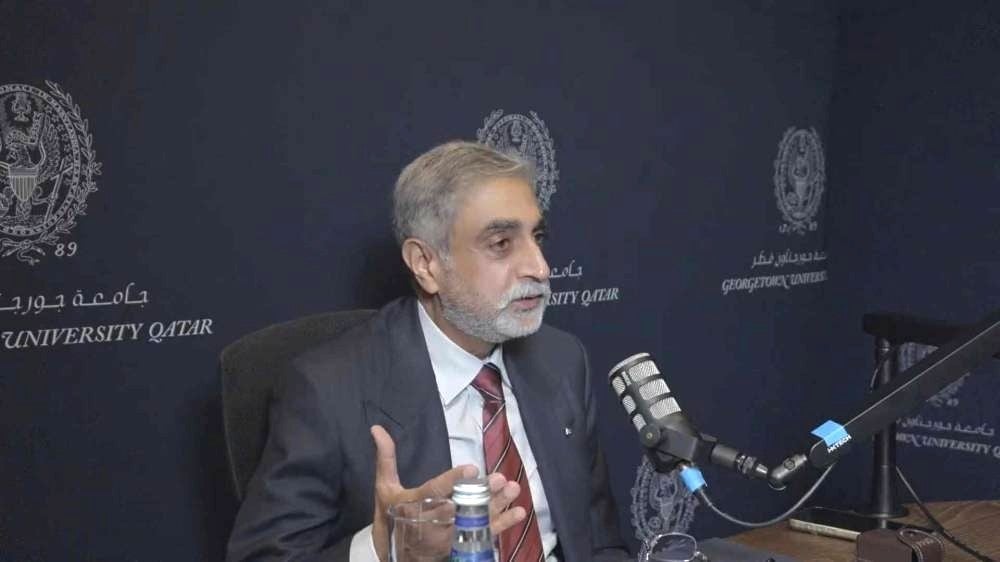
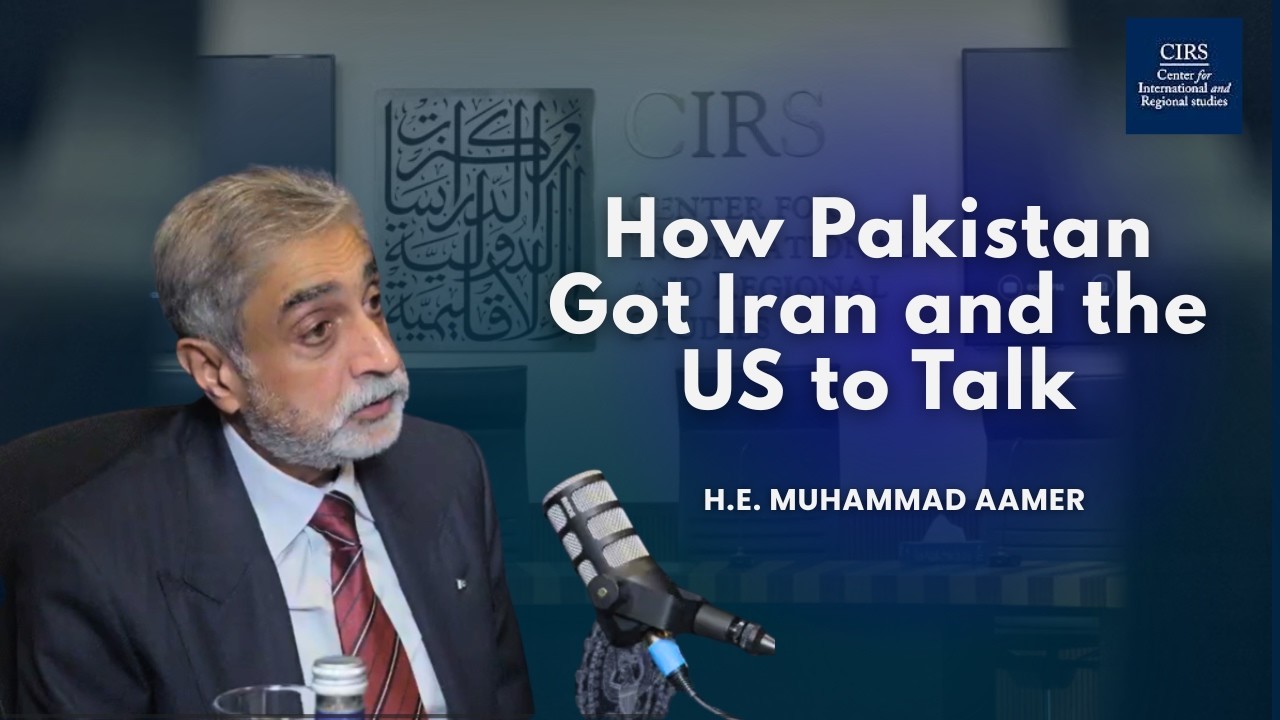
A rare interview with His Excellency Ambassador Muhammad Aamer, Pakistan’s Ambassador to Qatar, on diplomacy throughout the U.S.-Israeli war with Iran
About two years ago, Iran and Pakistan looked like adversaries. The two countries exchanged strikes over a two-day span in what felt like a major escalation, threatening both bilateral ties and regional stability. Fast forward to April 11, more than two years later, and Pakistan was hosting the first public, face-to-face negotiations between Iran and the United States since 1979. Previous engagements had taken place through third-party intermediaries.
As tensions escalated during the U.S.- Israeli war with Iran, a familiar set of mediators stepped in at different moments, including Qatar, along with countries like Oman, Turkey, and Egypt in supporting roles. Qatar’s involvement was expected, but Pakistan’s was not.
In a rare interview with Georgetown University in Qatar’s Center for International and Regional Studies, Ambassador Muhammad Aamer outlined how Pakistan helped facilitate direct engagement between Iran and the United States. The effort culminated in what is now known as the Islamabad Process, a sustained diplomatic track that led to the forthcoming Islamabad Memorandum, a 14-point ceasefire framework mediated by Pakistan to halt the 15-week war.
This interview was recorded on June 14, before the memorandum was made public. In the episode, Ambassador Aamer offers insight into the process, as well as Pakistan’s growing role and standing on the global stage.
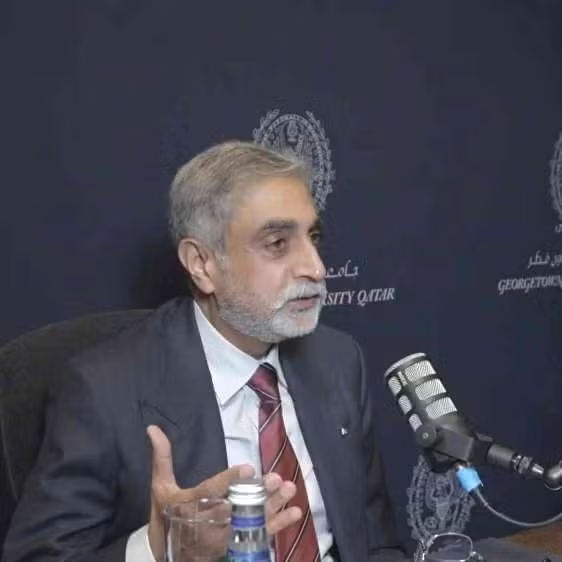
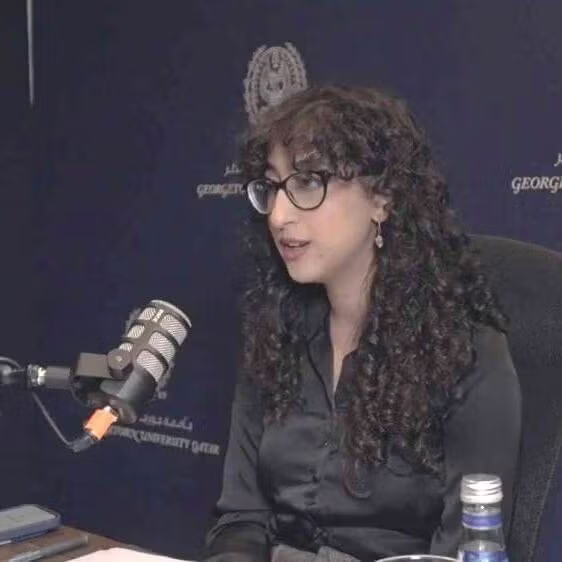
Take a listen to the podcast here:
An edited version of the conversation is also provided below:
Pakistan exchanged strikes with Iran in 2024, yet two years later Iran’s diplomat declared, “We will negotiate nowhere else but Islamabad.” How was that trust rebuilt? And what does Washington’s willingness to engage in Islamabad tell us about the current state of U.S.-Pakistan relations — is this strategic trust, or the absence of a better option?
Pakistan’s position today is not a one-off thing that simply emerged because of circumstances. We have to look at the history, the geography, the cultural ties with our neighbors, and the power structure of Pakistan — a nuclear state, a responsible country that has been part of major alliances and has played a significant role in organizations like the United Nations and ECO. This is something that was not built on any particular event.
As for the turbulence with Iran — we are neighbors. We share more than 900 kilometers of border. We have our problems and our disagreements on certain things. But we should look at the outcome: we sat down, ironed out the differences, and moved forward. We came out of that difficult situation with a great deal of trust developed between Pakistan and Iran.
On the United States: Pakistan and America have been very close partners, not only in the diplomatic field but in cultural and defense ties as well. Our security engagement goes back to the 1950s. Although there were difficult periods, our close cooperation across different fields never ended. We always kept the channels open, kept talking and collaborating, and helped each other wherever we could.
The ties with the GCC countries run deeper than most people realize. Around ten million Pakistanis are part of the development of those nations — their sweat and effort are embedded in the progress of those great countries. We have cultural and religious affinities with them, and so much in common that our ties are unbreakable. Our relations with China — economic, cultural, people-to-people — are exceptional. We are among the EU’s biggest trade partners. Name a country, and you will find that Pakistan is engaged with them in some meaningful way. It is the foundation of all these relationships that made us important enough, and strong enough, to take on the responsibility of facilitating mediation when something went wrong in the region.
Does Pakistan’s position also reflect a vacuum left by previous mediators? Oman and Qatar played important roles early on, but both were eventually constrained. Was this an opportunity Pakistan stepped into, or a gap it was pulled toward?
Let’s not start with a conclusion. When this conflict began, different countries were involved in mediation, and they did a marvelous job — Qatar especially is a powerhouse of mediation and negotiation with real expertise. But the situation evolved to a point where Pakistan had to come in, because a vacuum was created by the difficulties facing certain countries that were part of the conflict, as well as indecision on the part of others to step forward.
Pakistan has the best of ties with most countries in the world because we genuinely believe that peace and stability are the foundation of any region’s development. We have always maintained that justice and adherence to international norms pave the way for diplomatic solutions, regardless of how grave the situation is. We believe that dialogue and positive engagement are the only true path to conflict resolution.
That is the background to our role. We may not be a classical part of the Gulf, but we are affected by any turbulence there. Our diaspora of roughly ten million people has real interests in this region, and we cannot stay away from our friends when they are in trouble. The best way to help is to support dialogue rather than division. So we stepped in, developed the opportunity into something real, and took on the role of mediator and facilitator.
The Islamabad talks brought together 300 delegates from the United States and 70 from Iran across 21 hours and three rounds. What can you share about how Pakistan navigated that process, and what the dynamics of those conversations revealed?
I think, very honestly, that the details and storytelling are not what matters now — the Islamabad Accord is a reality. What I must highlight is that before the delegations arrived, and even before the talks formally began, it was Pakistan’s exhaustive prior deliberations that made everything possible. Our focus throughout was to sincerely start a process, not to create an event in Islamabad or generate headlines. That was never our aim.
You mention 21 hours — but you don’t know how many hours went in before that. Through our diplomatic efforts and sincere approach, we created a setting in which two sides entered the same room, sat at the same table, looked each other in the eye, and even shook hands after decades. Those 21 hours matter. But the 2,100 hours before them — and many more hours after — are what kept the process alive. The ceasefire held, with its challenges and its bad moments, but it held. The communication channels remained open.
The 21 hours are what the world sees. The efforts of Pakistan and our friends — Qatar, Saudi Arabia, China, Egypt, Turkey — are much greater than what is visible. This was a collective achievement, and I want to be very clear in acknowledging the sincere efforts of all those partners.
The talks were initially described as having “failed.” How do you distinguish a failed negotiation from the Islamabad Process that emerged from it, and what has sustaining that process required of Pakistan since?
I think the negotiations never failed. The expectations of the detractors failed. We should not expect a conflict rooted in history, with so many layers and technicalities between the United States and Iran, to be resolved in one sitting. Even today, after the Accord is signed, both sides will have to continue working through this process for months, perhaps years. The negotiations were never over — and it is evident that the process is alive. People are talking. We are moving forward.
One thing I want to be clear about: Pakistan never said and never expected to resolve all the differences between Iran and the United States in 21 hours. That might work in a classroom, in ideal conditions. But when people are sitting with the full weight of their nations behind them, with history pressing on them and pressures building — it is very difficult to resolve things in one sitting. What we did was facilitate a meeting between two countries the world thought would never share a table. That is the success of April 2026.
I am reminded of Churchill’s words: “Meeting jaw to jaw is better than war.” We believed that, and we worked to make it real.
The Islamabad Memorandum has been contrasted with frameworks like the JCPOA, which carried an undercurrent of Western-led pressure and punitive mechanisms. Is this a different kind of diplomacy — between equals, without coercive leverage?
Of course. Pakistan believes in the equality of nations — and this is not only Pakistan’s belief; the UN Charter states it very explicitly. So why not apply the UN Charter in practical terms? Why not mediate with sincerity? Why not mediate with frankness? Why not mediate with the trust level which is evident to both sides? And why not mediate without seeking any benefit out of this? And this is why I think that this process could bear fruits, could move forward, and could surprise its detractors at the end.
We had the support of the entire world. Our leadership met with Gulf leaders, American leaders, EU leaders, UK leaders, Chinese leaders — with the UN Secretary General as well. We consulted widely, shared our experience, and received guidance and feedback on how to move forward. So this was a collective effort, and Pakistan, while it contributed greatly, was not alone.
As for the JCPOA — I think that gave us a springboard. Everything is interconnected. We did not simply appear, set up a table, and make things happen. This process had roots in what came before. What we changed was the approach: a very sincere and frank engagement, eye to eye, rather than working through layers of intermediaries.
The talks have given rise to a new grouping — the Middle East Quadrilateral, with Egypt, Pakistan, Saudi Arabia, and Turkey explicitly backing Pakistani mediation. Are we witnessing a structural shift in where diplomatic agency resides? Is this evidence of a new role for middle powers in a multipolar world?
When we say the UN Security Council was absent or failed, I think the circumstances were such that multilateralism was pushed into the background, and regional powers with real stakes had to step forward — in proximity to the problem, with more intimate knowledge of it, and with genuine urgency to control the escalation. Those are the reasons.
But Pakistan very confidently says: the international system is still working. Middle powers are gaining more prominence in a changing world, and that is real — but it does not mean multilateralism has ended. If four countries are sitting together and carrying forward a dialogue, multilateralism is present. The difference is that it is now more focused on the immediate region, more indigenous, and more sincere about de-escalation.
We still believe in the United Nations. A former Secretary General once said that the United Nations was not created to take mankind to heaven — it was created to save us from hell. Seen from that perspective, what is happening now remains within the framework of UN resolutions. Pakistan in fact introduced a resolution last year promoting multilateralism, dialogue, and conflict resolution through mediation. The Islamabad Process is the practical manifestation of that resolution. Regional relationships are being built under the umbrella of the United Nations, grounded in mutual trust and shared stakes in the region’s future.
Pakistan imports 85% of its oil from the Gulf, and roughly ten million of its citizens live and work there. Does that economic stake actually strengthen Pakistan’s credibility as a mediator — does having skin in the game help?
I would say interdependence rather than dependency — when we buy, they sell. But yes, our stake is real. Our people’s presence in the region, our economic ties, our cultural and religious connections: all of these signal that Pakistan is not a disinterested outsider. We are a stakeholder in the fullest sense.
That said, I would not reduce Pakistan’s role to economics. Pakistan is a country of 250 million people, a nuclear power, a long-standing and active contributor to UN peacekeeping, and a significant player in ECO, SAARC, and other regional organizations. Pakistan is, I would say, a powerhouse of the region — but a powerhouse that poses no threat to anyone. We want the best relations with our neighbors and friends, near and far. We want to participate in the development and progress of our partners in the Gulf and beyond.
So if you say our skin is in this — well, our mind and heart are too. And that, I think, is why we have been successful.
What would it take for the Islamabad Memorandum to hold?
I am not good at speculation. But I think the countries and the stakeholders now have a very real chance to resolve their issues and pursue a peace that is enduring and that genuinely benefits their peoples. I do not say this will resolve everything — as I have said before, it gives both sides the chance to sit down, to move forward in a diplomatic and professional way, to iron out differences, and talk with each other directly rather than depending on intermediaries or communicating only through social media.
Diplomacy is a technical and discreet discipline — one that requires a great deal of thought before uttering even a single word. Both sides now need to give it that space. They need to listen to each other’s concerns and sincerely work to address them. The channels are open. What remains is the will to use them — not just for the region, but for the world beyond it as well.
Filed under
Read More
Can fiction about animal minds help us bridge the human divide? This professor thinks so.
A region is more than its headlines: Preserving the history of the Afghanistan-Pakistan frontier