The country His Highness saw coming
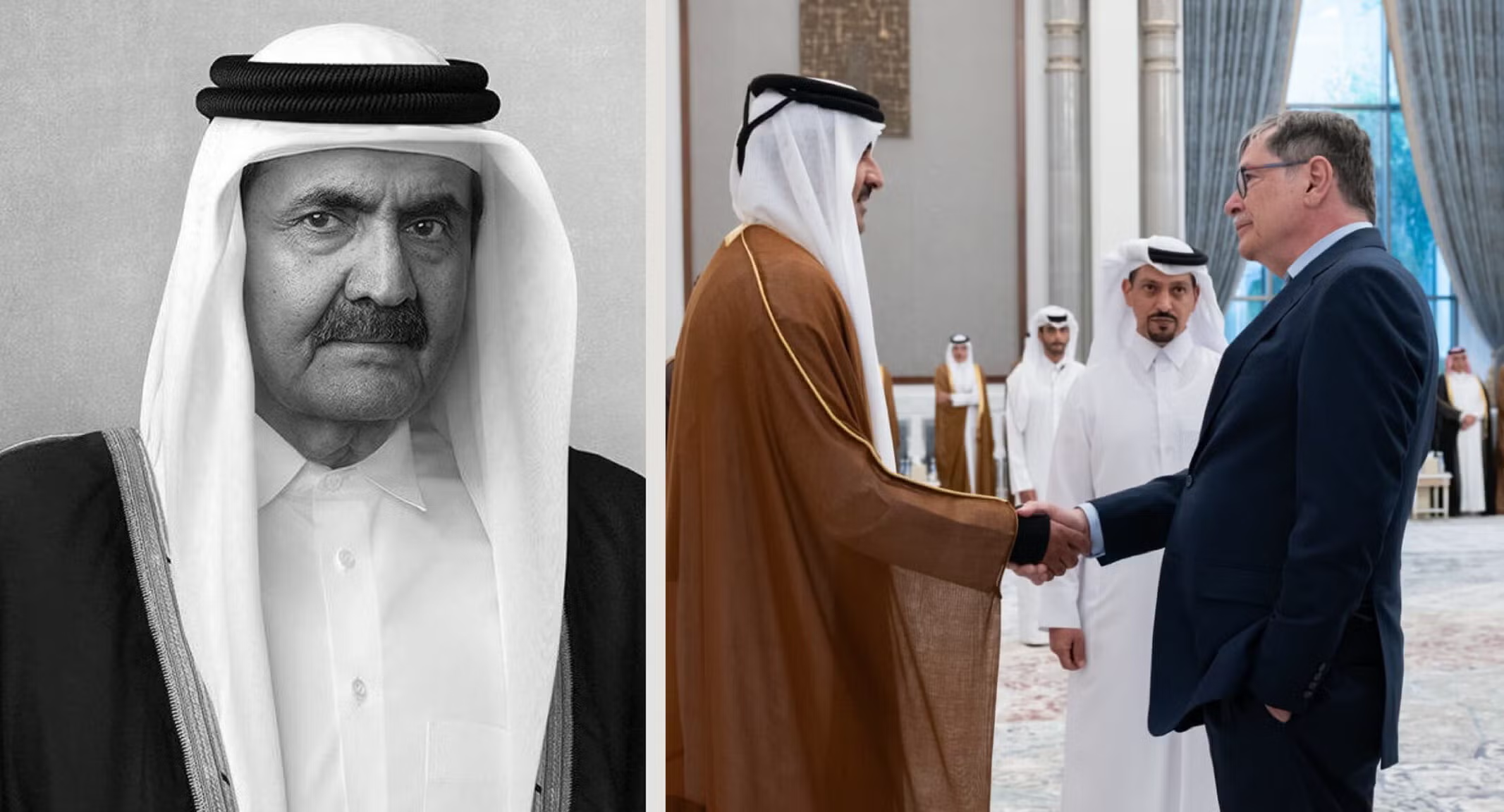
Remembering His Highness Sheikh Hamad bin Khalifa Al Thani, the late Father Amir of Qatar
When His Highness Sheikh Hamad bin Khalifa Al Thani arrived at Georgetown University in Qatar’s inaugural convocation, in August 2005, the university existed mostly in the future tense.
There were about twenty-five students, seven faculty members, a skeletal staff, and the promise of a School of Foreign Service education transplanted—intact and ambitious—from Washington to Doha. The first alumni were four years away. The traditions would begin with the people gathered there. Almost every sentence spoken about GU-Q included the word will.
Hussein Aldobashi stood among those waiting to greet His Highness. He was twenty-five, Georgetown’s first local employee, officially assigned to human resources but, in those early days, doing whatever needed to be done. He wore a plain academic gown among the doctoral robes of the faculty. He had not yet earned a university degree.
His Highness asked his name.
Then he asked his tribe.
Hussein answered. His Highness knew the family at once.
The exchange lasted only a few moments. “I was nervous and excited, but I also felt very proud,” Hussein recalled. “What amazed me was how much he knew about his people. He heard my name and immediately knew my family and where we came from.”
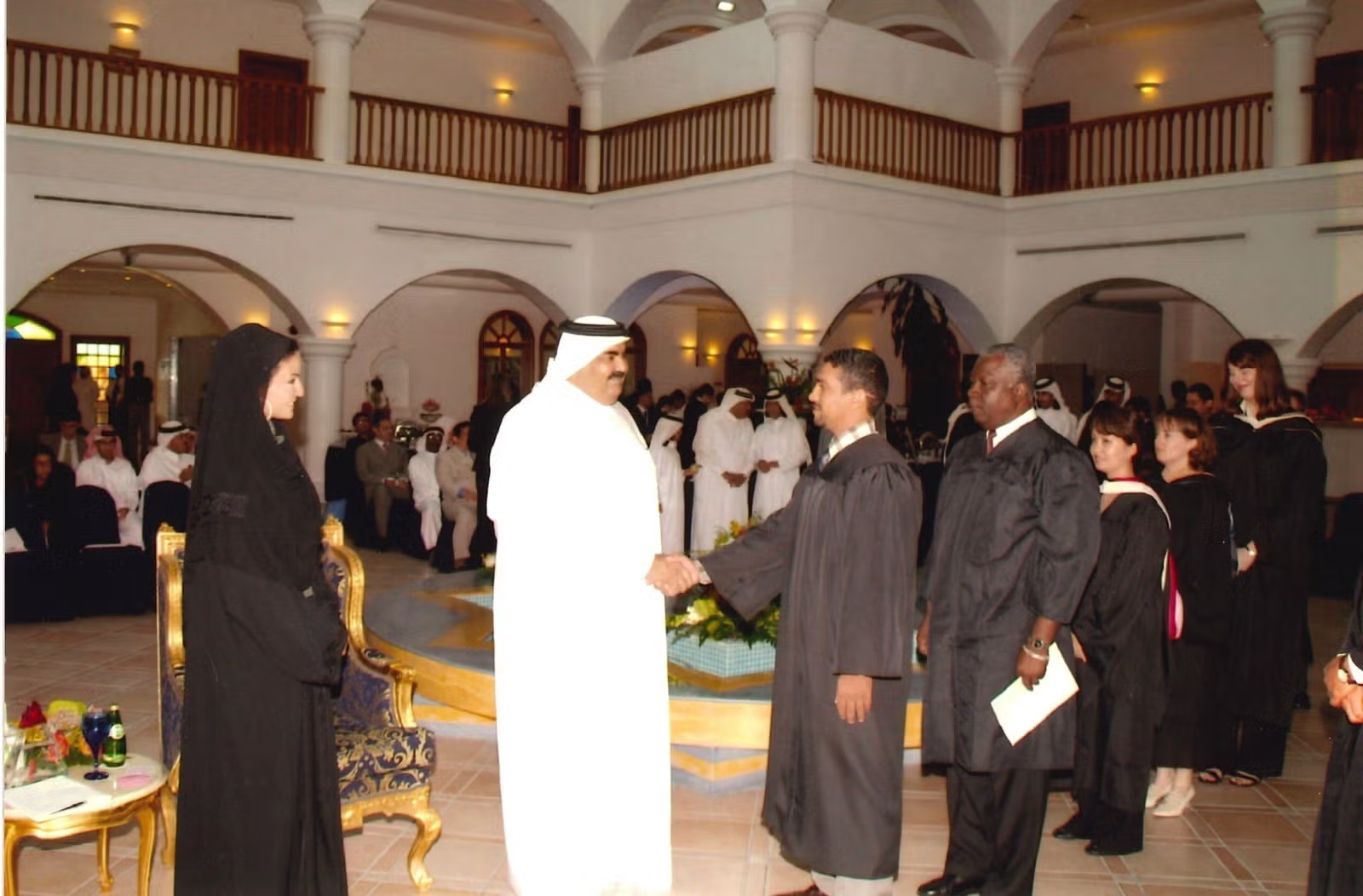
His Highness Sheikh Hamad bin Khalifa Al Thani greets Hussein Aldobashi at GU-Q’s inaugural convocation in August 2005.
At the time, His Highness was making decisions about gas fields, ports, universities, airlines, television networks, investments, and regional conflicts. Yet in that small gathering, he paused over Georgetown’s youngest and newest employee and the history contained in his name.
Much of the country taking shape around them that evening—not just Georgetown—still belonged to the future.
Education City was young. Qatar Airways was extending its reach. I. M. Pei’s limestone monument to Islamic art had yet to take its place on the water. Qatar’s bid to host the World Cup was still four years from being formally submitted.
Modern Qatar still lay beyond what many people considered plausible.
His Highness was bringing it into view.
The work had begun a decade earlier.
When His Highness assumed power in June 1995, Qatar possessed an extraordinary natural resource and the opportunity to remake the country with it.
The North Field lay beneath the sea, immense, but the system that would turn gas into national wealth was still being assembled: Ras Laffan, liquefaction trains, shipping fleets, long-term agreements, and technical capacity. The first shipment of Qatari liquefied natural gas left in 1996. Within a decade, Qatar had become the world’s largest exporter. By 2010, its annual production capacity had reached 77 million tons.
The breathless transformation could be seen across Doha. The low city of earlier decades began to rise and spread as towers appeared along the Corniche and in Al Dafna, roads widened and curved outward, and new districts emerged beyond the old center.
Yet the deeper measure of change was how much more securely people could live and plan for the future.
Qatar expanded social protection for widows, divorced women, families in need, people with disabilities, orphans, and the elderly. Public-sector salaries and pensions rose. Hamad Medical Corporation grew from three hospitals in 1998 to eight by 2012, adding dedicated heart and cancer facilities and extending hospital care beyond central Doha.
In a 2012 interview for CBS’s 60 Minutes, America’s longest-running television newsmagazine program, correspondent Bob Simon listed some of the benefits Qatari citizens had come to enjoy: no taxes, free electricity, free health care, and free education.
“Sounds like a paradise,” Simon said.
“Well,” His Highness replied, “I welcome you in this paradise.”
Beneath the warmth was a governing conviction: national wealth should be felt in ordinary life.
Education was central to that effort.
Qatar Foundation was established in 1995. His Highness and Her Highness Sheikha Moza bint Nasser shared the ambition behind it. Her Highness articulated its intellectual vision and guided its growth at every stage. His Highness made it a national priority and committed to it the resources of the state.
What began with a single school grew into Education City. Leading universities arrived from abroad. Laboratories, libraries, clinics, research centers, and cultural spaces followed. Doha announced itself as a center of intellectual exchange, allowing young people to receive a world-class education close to home while drawing international institutions into deeper engagement with the Arab world and the wider Global South.
Georgetown became part of that experiment in 2005.
“Georgetown was deeply honored by the invitation of His Highness and Her Highness Sheikha Moza to participate in this educational community in Doha,” said Georgetown University President Eduardo M. Peñalver. “The opportunity reflected a distinctly Jesuit intuition: that sustained encounters across faiths and cultures create the opportunity for a deeper, more nuanced understanding of our world.”
Her Highness Sheikha Moza spoke of educating “the diplomats of the future.” His Highness understood what modest beginnings could conceal. GU-Q’s first class was small, and Qatar’s ambitions were still widely—and wildly—underestimated.
Neither offered a reliable measure of what was to come.
The first cohort comprised twelve Qataris and thirteen students representing ten other nationalities, nearly all already living in Doha. Two decades later, GU-Q’s alumni number more than a thousand, representing over eighty nationalities. They serve across ministries, international organizations, businesses, newsrooms, universities, and public life.
On June 25, 2013, His Highness addressed the nation. The time had come, he said, for a new generation to assume responsibility.
In his final address as Amir, His Highness spoke of power in moral and personal terms. “I had not desired power for the sake of power,” he said.
He expressed confidence that the Heir Apparent, His Highness Sheikh Tamim bin Hamad Al Thani, could carry the amanah, the trust, and fulfill the risalah, the mission, with “the happiness of the Qatari person” as his foremost goal.
For eighteen years, His Highness had asked Qatar to believe in what came next.
In the end, he did the same himself.
GU-Q Acting Dean Clyde Wilcox arrived in Doha during the leadership transition, as a scholar of politics. “I immediately understood how rare such a moment was. His Highness transferred power at the height of his authority and did so with complete confidence in the country, its institutions, and the generation that would follow him. It was an act of statesmanship commensurate with the transformation he had led.”
Afterward, the nation came to know His Highness as the Father Amir.
For many younger Qataris, the country he helped build was simply the country they knew. Qatar Airways had always reached across the world. Al Jazeera had always broadcast the region’s arguments, upheavals, and ambitions from Doha. Education City had always been a priceless collection of the world’s leading universities. Qatar had always hosted negotiations and international events.
Perhaps that is one measure of political achievement: the improbable endures until it becomes inevitable.
When His Highness passed away on July 12, 2026, Qatar entered four days of public mourning. At Lusail Palace, leaders, dignitaries, and citizens came to offer their condolences to His Highness Sheikh Tamim bin Hamad Al Thani. Among the mourners were Acting Dean Clyde Wilcox, Associate Professor of Government Paul Musgrave, and Hussein Aldobashi.
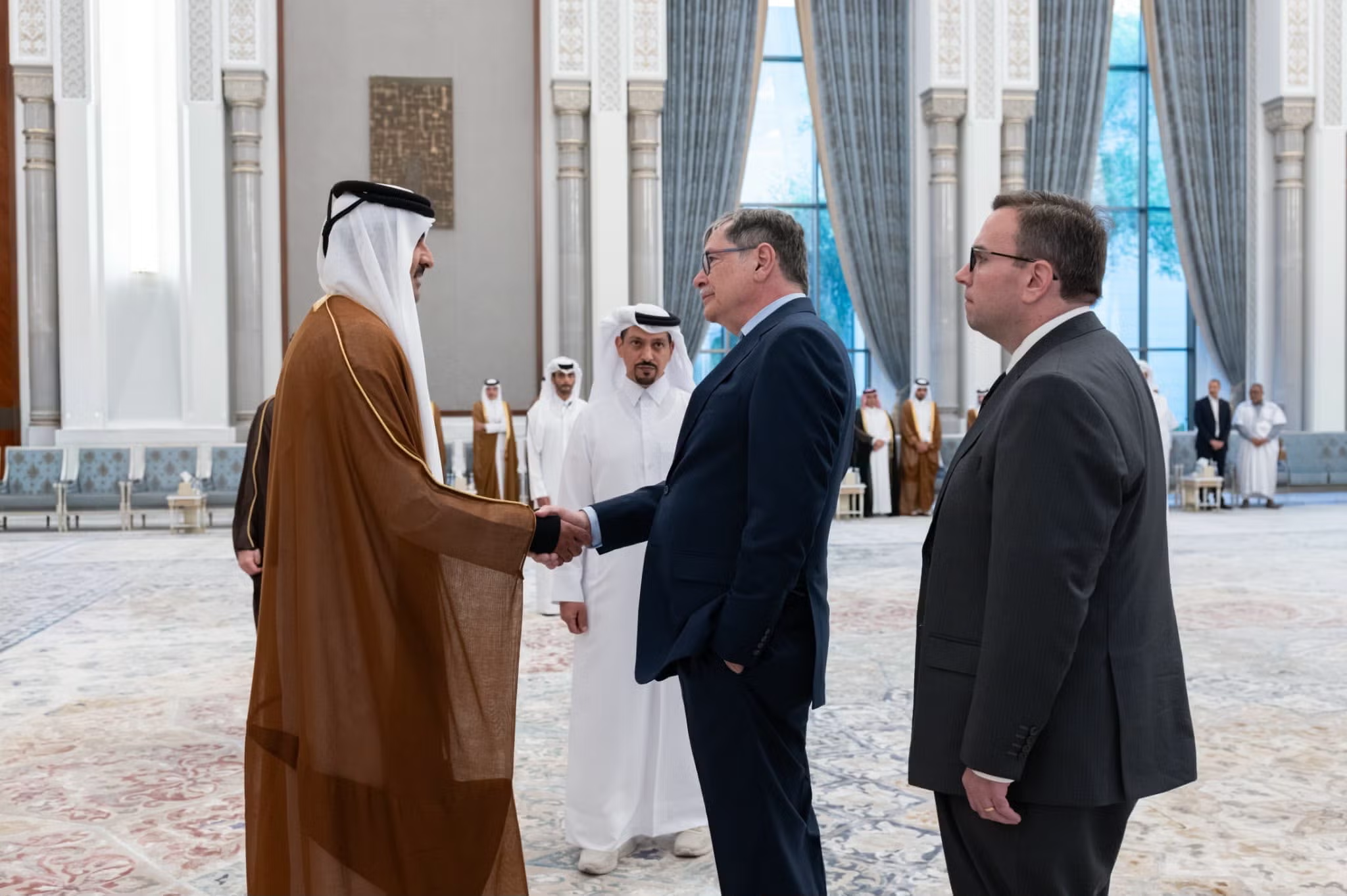
His Highness Sheikh Tamim bin Hamad Al Thani (left) receives condolences at Lusail Palace from GU-Q Acting Dean Clyde Wilcox (center right), alongside Dr. Hussein Aldobashi (center) and Dr. Paul Musgrave (right).
By then, Hussein was now Dr. Hussein Aldobashi, an associate director at GU-Q.
Between the young man in the plain academic gown and the scholar who returned to pay his respects lay a bachelor’s degree, four master’s degrees, and a doctorate.
Hussein’s story was also Qatar’s.
Georgetown, too, had crossed from promise into permanence. More than a thousand graduates had gone on to serve in Qatar and around the world. Through its Executive Master’s in Diplomacy and International Affairs, the university’s mission had also reached experienced Qatari professionals already bearing national responsibilities.
Last year, Georgetown and Qatar Foundation renewed their partnership for another decade.
A university founded in 1789 had become part of the country that imagined a place for it. It belonged now to Qatar’s history—and, through its students and alumni, to a future still shimmering into view.
The faculty, staff, and students of Georgetown University in Qatar mourn His Highness Sheikh Hamad bin Khalifa Al Thani with profound respect and gratitude for the enduring legacy he leaves behind. May God have mercy on him and grant him eternal peace.
إِنَّا لِلَّٰهِ وَإِنَّا إِلَيْهِ رَاجِعُونَ
Filed under
Read More
Can fiction about animal minds help us bridge the human divide? This professor thinks so.
A region is more than its headlines: Preserving the history of the Afghanistan-Pakistan frontier