History in the making: How one alumna is putting her degree to work in Ethiopia
International History (IHIS) major Ayah Mohammed (GU-Q ’24) has a hard time explaining what she does in just one sentence.
One day, she is advising on investment opportunities, trade and business growth across African markets. The next, she is helping returnee migrants rebuild their lives or figuring out how to get soap and menstrual hygiene supplies into a maternity ward in Addis Ababa.
The work may look unrelated, but to Mohammed, the connection is clear. Her IHIS degree from Georgetown University in Qatar taught her to look beyond the problem in front of her, understand what shaped it and ask a question that continues to guide her work: How did we get here?
Today, Mohammed is a senior analyst at Connect Africa Capital, an investment and advisory firm connecting investors with growing African businesses. She is also a business analyst at Alkebulan, a startup working to build a trade house in Ethiopia. Together, the roles give her a close view of Ethiopia’s changing economy as the country opens further to global markets.
“These companies aren’t operating under strictly traditional corporate models,” Mohammed said. “They bring capital into Ethiopia as the country opens up through foreign banks and service providers. We help make those connections happen, and it’s a critical space for young people who want to help Ethiopia thrive.”

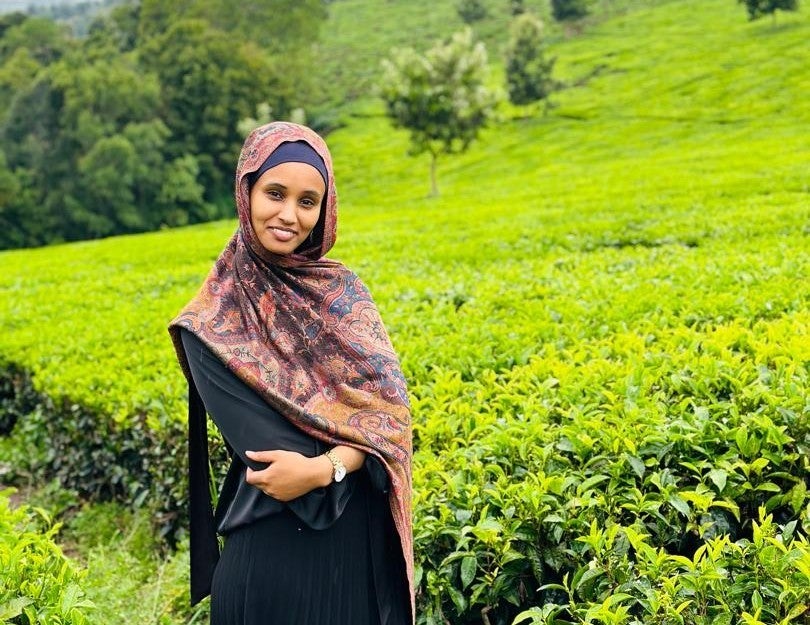
Ayah Mohammed (GU-Q ’24) visiting tea fields in Kikuyu, Kenya, while working for the Africa Women Agribusiness Network (AWAN Afrika) in 2023.
But some of her most direct work happens far outside her corporate schedule.
This summer, Mohammed organized a dignity kit drive for mothers in the neonatal intensive care unit at the Gandhi Memorial Hospital in Addis Ababa. The kits contained basic essentials such as soap, underwear and menstrual hygiene supplies, items that can be difficult for women across Ethiopia to access amid internal conflict, drought and broken supply chains.
Getting those supplies through the hospital doors was not as simple as collecting them. Mohammed had to navigate local bureaucracy, figuring out who to talk to, how to approach them and when to push.
“You have to be diplomatic,” Mohammed said. “You can’t walk in and demand things. You have to understand who you’re dealing with, build relationships and figure out how to get things done. Sometimes that means complimenting somebody’s lipstick to get through the door before you say, ‘I’m here to help.’”
It is a funny story, but it gets at something Mohammed takes seriously. Before she can help solve a problem, she wants to understand it, including the history and circumstances that made it a problem in the first place.
At GU-Q, she learned that history was not simply about knowing what happened. It was about understanding why it happened, what came before it and how those decisions continue to shape people’s lives.
“People have stopped recognizing the person on the other side as a human being,” Mohammed said. “History humanizes. It brings empathy and context.”
She does not believe you need to study a particular region’s history to understand its current problems. Her classes, for example, Environmental History with Professor Trish Kahle, taught her to look at the bigger picture and understand how different issues overlap. In Ethiopia, that can mean looking at climate pressures alongside economic challenges, conflict and access to basic services rather than treating each issue as an isolated problem.

Mohammed at the African Union Headquarters in Addis Ababa, Ethiopia for the AU Youth Conference in 2024
She also left GU-Q with something more immediately practical: language skills. Mohammed completed more than a dozen Arabic courses and became fluent. Combined with her native Amharic, those skills allow her to move between the Gulf and East Africa with ease. In early 2025, that combination helped her stand out when she consulted for Qatar Charity’s Field Office in Addis Ababa, where she managed child sponsorship programs supporting more than 1,000 young people through age 25.
“Qatar Charity was a very new office at the time,” Mohammed said. “They needed someone who could bridge both worlds, speak Amharic and Arabic, and fit into the local context. My training wasn’t just writing research papers, it was understanding context, translating complex issues and hitting deadlines.”
Her work in Ethiopia also brought her closer to a community she cares about deeply: women who migrated along dangerous routes to work in the Gulf and Yemen, then returned home to face severe economic and social challenges.
Through the Good Samaritan Association, Mohammed supports shelters that provide emergency housing, job training and business stipends to help returnees rebuild their lives. That work eventually led her to another fellowship, where she collaborates with practitioners from Sri Lanka, Nepal and India on international migrant rights.
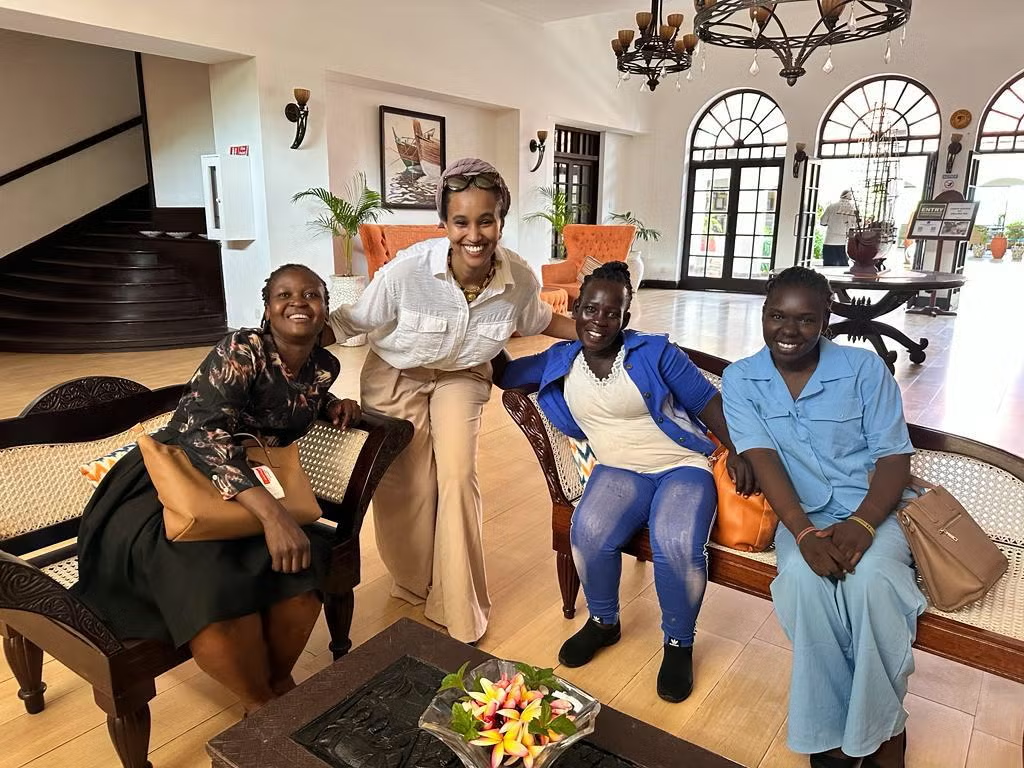
Mohammed welcoming South Sudan delegates for AWAN Afrika to Mombasa, Kenya in 2023
Investment, trade, migrant advocacy and community work may seem like separate paths, but for Mohammed, they all come back to the same thing: understanding people, the systems that shape their lives and how those people and systems overlap.
That is also the advice she would give GU-Q students. Choose a major based on what you genuinely care about, she says, rather than trying to predict exactly where it will take you. The skills she developed through International History have followed her into every part of her work, from analyzing complex systems and understanding different cultures to figuring out how to navigate local bureaucracies and deliver results.
“My overall goal is to support women, I’ll do it regardless of what my job title is,” Mohammed said. “Semantics don’t matter. At the end of the day, you’re working with people across different industries and history gives you the context to make things happen.”
Filed under
Read More
Can fiction about animal minds help us bridge the human divide? This professor thinks so.
A region is more than its headlines: Preserving the history of the Afghanistan-Pakistan frontier