How a QSTP startup founded by GU-Q students is taking education innovation to Sierra Leone
Written by Reve Chaaban, for QSTP
Muallemi began at Qatar Science & Technology Park as a GU-Q student founded edtech startup focused on a specific problem: helping students in Qatar close gaps in math and science through affordable, personalized tutoring.
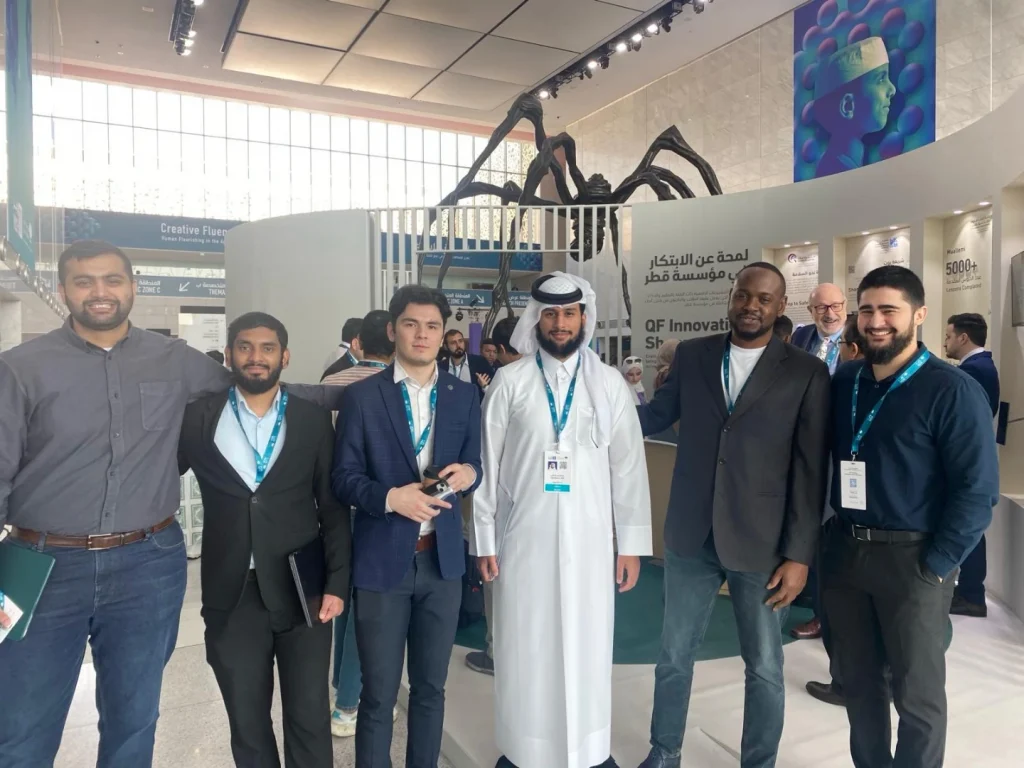
L to R: Muallemi team members Hisham Bin Hashim (GU-Q’16), co-founder Abdullah Nazeer (GU-Q’23), Saidalikhon Maksudkhonov (GU-Q’23), co-founder Abdulrahman F. Al-Thani (GU-Q’22), Ousman Camara (GU-Q’19), and Aminulloh Mamadziyoev (SFS’23) at the QF Innovation Showcase
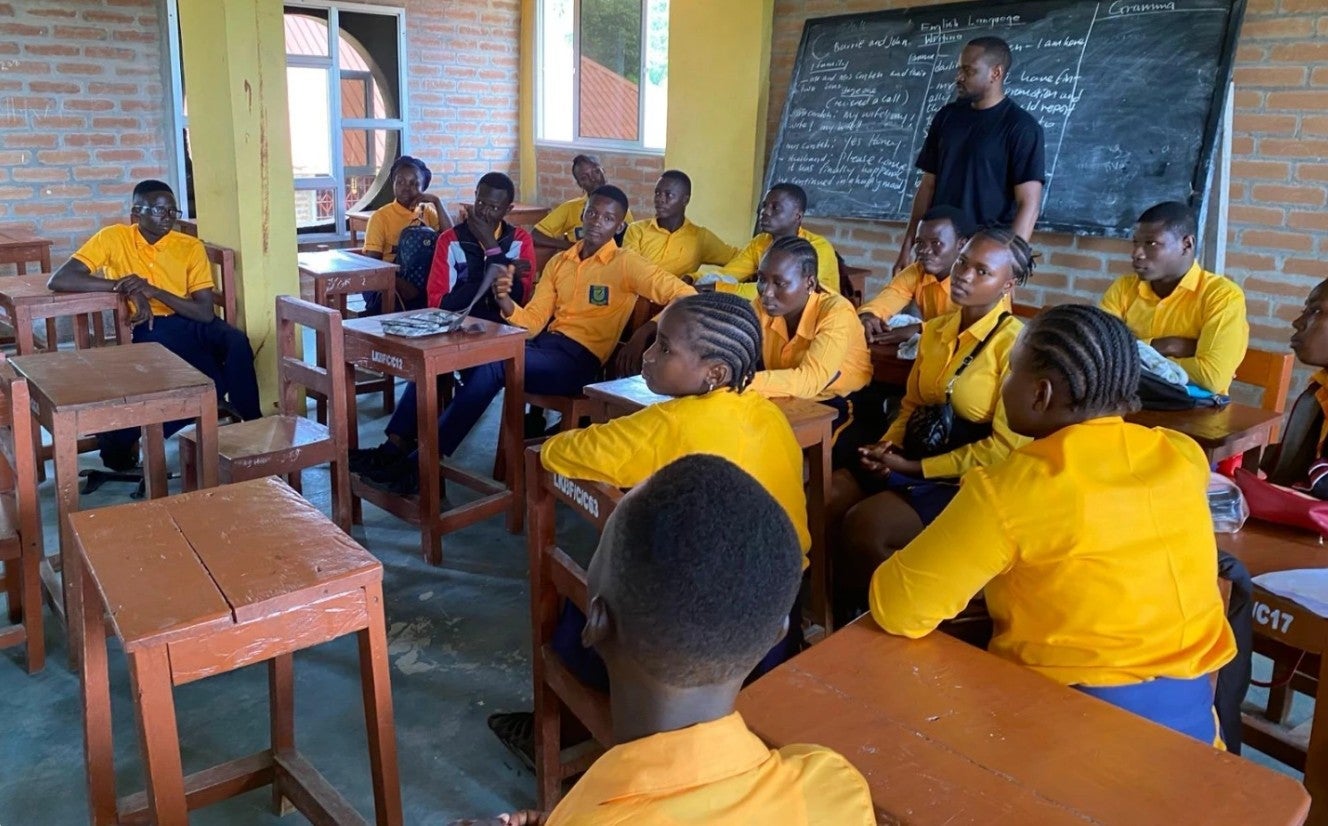
Today, the company is also supporting more than 350 students at the Lamin and Kadie Bah Academy in Makeni, Sierra Leone, through education transition programs, leadership development, mentorship and university readiness initiatives.
We spoke with Ousman Camara, Head of Education Innovation and Digital Transformation at Muallemi, about how the partnership came together and what it has taught the company along the way.
A partnership rooted in personal history
For Camara, the decision to work in Sierra Leone was never about entering a new market. “As an African, the continent is not simply a market or a location for expansion. It is part of who I am,” he explains. “My own journey has been shaped by educational opportunities, and I have experienced personally how access to quality education, mentorship and international exposure can change the direction of a young person’s life.”
Ousman Camara, Head of Education Innovation and Digital Transformation, Muallemi, running a program at Lamin and Kadie Bah Academy in Makeni, Sierra Leone
That personal history shaped how the partnership began. Rather than approaching Lamin and Kadie Bah Academy with a ready made solution, Muallemi’s team focused on understanding the school first. “What stood out was the alignment between their commitment to education and Muallemi’s mission to use technology, innovation and partnerships to expand access to quality learning,” he says. “The objective was never to arrive with the attitude that we had all the answers. It was to listen, understand the local context and work with educators who already understood their students and communities.”
Adapting the model, not transplanting it
One of the clearest lessons to come out of the partnership is that solutions built for one education system rarely transfer directly to another. Muallemi was developed within Qatar’s education and innovation ecosystem, but Sierra Leone brought its own curriculum, infrastructure and priorities.
“The question was not: how do we take the Qatar model and implement it in Sierra Leone,” he says. The better question was: how can Muallemi’s capabilities be adapted to support the needs of Sierra Leonean students and teachers.
That meant rethinking the approach around local realities, including varying levels of digital access, a stronger emphasis on teacher capacity building, and a deliberate choice to position technology as a support for teachers rather than a replacement for them. As he puts it, “technology should adapt to education systems, not education systems be forced to adapt to technology.”
What success looks like beyond the numbers
Reaching 350 students is a meaningful milestone, but for Camara, the number tells only part of the story. The deeper measure of impact is the shift in how students see their own futures.
“We have seen students develop greater confidence in communication, improve their digital skills, strengthen their approach to learning and begin thinking more seriously about university, careers and their future,” he says. “Sometimes the greatest barrier facing a young person is not a lack of intelligence or ambition. It is the belief that certain opportunities are not meant for someone like them. Education can change that belief.”
That shift, from doubt to the simple statement of “I can go to university” or “I can become an engineer,” is what the team considers the real return on the partnership.
“The question we ask today is no longer simply how can we improve learning,” says Camara. “It is also how can we help a student move from the classroom to a successful and meaningful future.”
Building toward what comes next
Muallemi’s ambitions for Sierra Leone and beyond are deliberately measured. Rather than chasing scale for its own sake, the team is focused on partnerships that are sustainable and locally relevant, with conversations already underway across other parts of Africa. “We do not believe in a one size fits all model,” he notes. “Our role is to bring the right technology, expertise and partnerships to support local priorities.”
The story of Muallemi and Lamin and Kadie Bah Academy is, at its core, a story about what an idea incubated in Qatar can become once it is given room to grow, tested against real world problems and connected to the right partners.
More about Muallemi and Ousman Camara
Filed under
Read More
Can fiction about animal minds help us bridge the human divide? This professor thinks so.
A region is more than its headlines: Preserving the history of the Afghanistan-Pakistan frontier